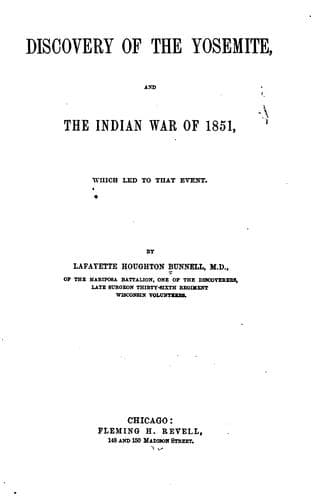
Discovery of the Yosemite, and the Indian War of 1851, Which Led to That EventBunnell, Lafayette Houghton
History
Discovery of the Yosemite, and the Indian War of 1851, Which Led to That Event
Bunnell, Lafayette Houghton
Indians of North America -- California; Pacific Coast Indians, Wars with, 1847-1865; Yosemite Valley (Calif.)
All spirits that had not been released and taken their flight to their
happy Western spirit-land were considered as evil; and only the Great
Spirit was believed to be very good. The Indians of the Yosemite
Valley did not look upon Tote-ack-ah-nü-lah as a veritable Deity or
“semi-Deity.” They looked upon this cliff, and the representation
of the likeness of a human face, with the same mysterious awe and
superstitious feeling that they entertained for some other objects;
though perhaps their reverence was in a somewhat higher degree
stimulated by this imposing human appearance; and their ability,
therefore, the better to personify it. They regarded this vast mountain
as an emblem of some mysterious power, beyond their comprehension.
From my knowledge of their _religious belief_, I have come to the
conclusion that their ideas in this direction are wholly spiritual,
without material representation, except as stated, through symbolic
ideas, growing out of their superstitious ignorance, like some ignorant
Christians. They have in imagination peopled the rocks and mountains,
woods and valleys, streams and waterfalls with innumerable spiritual
occupants, possessed of supernatural or spiritual powers, none of which
are believed by them to equal the power of the Great Spirit whose home
is in the West, and who prohibits the return of the evil ones, until a
probationary existence here upon this earth shall have given them such
knowledge of and disgust with evil as will fit them for the enjoyment
of good.
The special inconsistency of this belief seems to be, that if one
of these demons can lure any one to destruction, the victim will be
compelled to take the place and occupation of the evil spirit, who
is at once liberated and takes its flight to join its family or such
members of it, as are already with the blessed. This idea seemed to be
based upon the natural selfishness of human nature, that would gladly
fix its responsibilities and sufferings upon another. A writer in
his descriptions of the Yosemite says: “The savage lowers his voice
to a whisper, and crouches tremblingly past Po-ho-no, while the very
utterance of the name is so dreaded by him, that the discoverers of the
valley obtained it with difficulty.” These statements were prefaced
by the assertion that “Po-ho-no is an evil spirit of the Indians’
mythology.” On our second visit to the valley, it will be remembered,
we found huts built by the Yosemites not far from the Po-ho-no Fall.
I never found any difficulty in learning the name of this fall, or
observed any more fear of spirits exhibited at this fall than at the
Yosemite fall; but in later years, for causes that will appear in the
course of this narrative, the little meadow and detached rocks west of
Po-ho-no, and near to the foot of the Mariposa trail; became haunted
ground to the remnant of the band, for disaster and death followed the
commission of crime at that locality.
Public-domain text, read in full here on John Shaqi.
Reviews
Reviews
No reviews yet
Be the first to share your thoughts on this work.
Elsewhere in the archive
Join the Discussion
Join the discussion
Sign in to leave a comment or review.
Sign InorCreate an account