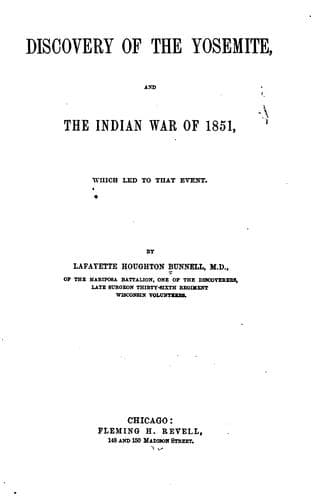
Discovery of the Yosemite, and the Indian War of 1851, Which Led to That EventBunnell, Lafayette Houghton
History
Discovery of the Yosemite, and the Indian War of 1851, Which Led to That Event
Bunnell, Lafayette Houghton
Indians of North America -- California; Pacific Coast Indians, Wars with, 1847-1865; Yosemite Valley (Calif.)
Savages are seldom able to trace to themselves the cause of misfortune,
and hence evil spirits must bear the burden of their complaint. For
this service they are well paid through their representatives, the
“medicine men.” I have often been amused, and agreeably entertained
while listening to their traditionary literature.
Among the Chippewa and Dahcota tribes, my likeness to a brother,
who was a trader, was recognized, and many times I was honored by a
prominent place being given me in their lodges and at their dances.
Some of their mysteries I was not permitted to witness, but the
consecration of the ground for the dance, which is performed with great
ceremony, I have several times seen, and had its signification fully
explained to me. The ceremony differs but little among the different
tribes, and consists of invocations, burning incense, scattering
down, feathers and evergreens upon the pathway or floor of the dance,
lighting of the sacred fires with their ancient fire-sticks, which are
still preserved among the priests, and repeating certain cabalistic
words, the meaning of which they do not even pretend to understand,
but which are supposed to have a most potent influence. They also
have their pantomimes and romances, which they repeat to each other
like children. This legendary literature is largely imaginative, but
I found the California Indians less poetical in thought and feeling
than eastern tribes, and less musical, though perhaps as primitively
figurative in expression.
Though seemingly unimpressed by their sublime surroundings, their
figures and comparisons, when not objectionable, were beautiful,
because natural. The Pai-ute and Mono Colony originally established
by Ten-ie-ya, was the result of a desire to improve their physical
condition. They were attached to this valley as a home. The
instinctive attraction that an Indian has for his place of nativity
is incomprehensible; it is more than a religious sentiment; it is a
passion. Here, sheltered in a measure from the storms of winter, and
the burning heat of summer, they met as in an earthly paradise, to
exchange the products of either side of the Sierras, to engage in a
grand hunt and festival offer up religious sacrifices, and awaken the
echoes of the valley with their vociferous orations. Should their skill
fail them in the chase, and the mountain or brook refuse their luscious
offerings, they had a never-failing resource in the skill with which
they could dispossess the native Californian, or the newly arrived
immigrant of his much prized herds, and _translate_ them to their
mountain home. Nor was there need of herd-men to guard their fleecy
flocks or roving herds, for the prancing horse or gentle kine, having
once been slid over the slippery gateway, avoided the obstruction ever
after; and remained contented in their fields of blue grass and clover.
[Illustration: THE INDIAN BELLE.]
Public-domain text, read in full here on John Shaqi.
Reviews
Reviews
No reviews yet
Be the first to share your thoughts on this work.
Elsewhere in the archive
Join the Discussion
Join the discussion
Sign in to leave a comment or review.
Sign InorCreate an account