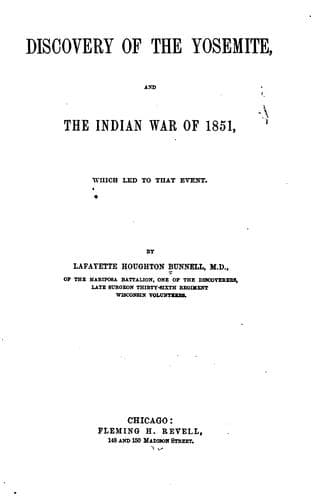
Discovery of the Yosemite, and the Indian War of 1851, Which Led to That EventBunnell, Lafayette Houghton
History
Discovery of the Yosemite, and the Indian War of 1851, Which Led to That Event
Bunnell, Lafayette Houghton
Indians of North America -- California; Pacific Coast Indians, Wars with, 1847-1865; Yosemite Valley (Calif.)
We reached our camp in the valley without accident. Captain Boling at
once gave orders to make preparations for our return to the Fresno. The
next day we broke camp and moved down to the lower end of the valley
near where we camped on the first night of our discovery, near the
little meadow at the foot of the Mariposa Trail.
At sunrise the next morning, or rather as the reflections on the cliffs
indicated sunrise, we commenced our ascent of the steep trail. As I
reached the height of land where the moving column would soon perhaps
forever shut out from view the immortal “Rock Chief,” my old sympathies
returned, and leaving the command to pursue its heedless way, I climbed
to my old perch where Savage had warned me of danger. As I looked back
upon El Capitan, his bald forehead was cooling in the breeze that swept
by me from the “_Summer land_” _below_, and his cheerful countenance
reflected back the glory of the rising sun. Feeling my own inferiority
while acknowledging the majesty of the scene, I looked back from Mt.
Beatitude, and quoting from Byron, exclaimed:
Yosemite!
“Thy vale(s) of evergreen, thy hills of snow
Proclaim thee Nature’s varied favorite now.”
We reached the Fresno without the loss of a captive, and as we turned
them over to the agent, we were formally commended for the success of
the expedition.
CHAPTER XV.
The Flora of the Region of the Yosemite--General Description of the
Valley and its Principal Points of Interest, with their Heights.
A marked and peculiar feature observed in the landscape of the
Merced River slopes, while going to the Yosemite, especially on the
Coultersville route, is the dense growth of the chamiso and the
manzanita. These shrubs are found most abundant below the altitude
of the growth of sugar-pine, upon dry, slaty ground; though a larger
variety of manzanita, distinguishable by its larger blossoms and fruit,
and its love of shade and moist clay-slate soil, may be found growing
even among the sugar-pine. A peculiarity of this shrub is, that like
the Madroña and some trees in Australia, it sheds a portion of its
outer bark annually, leaving its branches beautifully bright and clean.
The manzanita, when in full bloom, is one of the most beautiful of
shrubs; its delicately tinted and fragrant blossoms filling the air
with the perfume of an apple-orchard, while its rich evergreen leaves
are only shed as others put forth. The name, manzanita, is Spanish,
signifying little apple--the fruit in flavor, but more especially in
smell, resembling the apple.
Public-domain text, read in full here on John Shaqi.
Reviews
Reviews
No reviews yet
Be the first to share your thoughts on this work.
Elsewhere in the archive
Join the Discussion
Join the discussion
Sign in to leave a comment or review.
Sign InorCreate an account