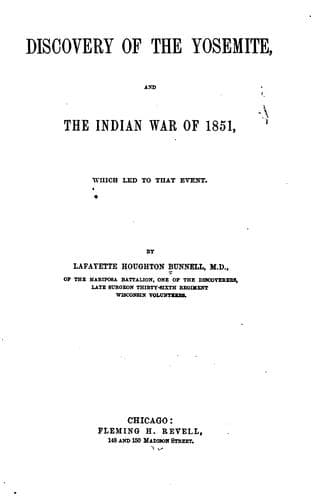
Discovery of the Yosemite, and the Indian War of 1851, Which Led to That EventBunnell, Lafayette Houghton
History
Discovery of the Yosemite, and the Indian War of 1851, Which Led to That Event
Bunnell, Lafayette Houghton
Indians of North America -- California; Pacific Coast Indians, Wars with, 1847-1865; Yosemite Valley (Calif.)
These chamiso and manzanita thickets are almost impenetrable to large
animals, except the California lion and grizzly bear. At certain
seasons of the year, during their trips to and from the High Sierras,
when the berries are ripe, these coverts are the resort of such
visitors. The grizzly comes to indulge his fondness for the little
apples, and the lion (how hath the mighty fallen!) to feed upon the
wood-rats, mice and rabbits that he surprises in these furzy thickets.
Occasionally a deer, as he comes along unconscious of danger, but too
near the feline lair, is pounced upon by the lion, or perhaps a stray
horse or mule may fall a victim; but in no case dare the lion attack
his savage associate the bear, or any of his progeny.
In going to the Yosemite by way of the Mariposa route, after reaching
the summit of the gap or pass in the “Black Ridge” or Chow-chilla
mountain, over which the Mariposa route passes, to the South Fork of
the Merced River, the yellow pine, the sugar pine, the Douglass fir
and two other species of fir, are seen in all their glory. Here, too,
is to be found the variety of white or yellow cedar (_Libo cedrus
decurrens_), growing to a size not seen at a less altitude, unless
perhaps on the north side of some spur from these mountains. If the
ridge be followed to the right as far as the Big Trees, instead of
descending the road to the South Fork, some very large pine, cedar
and fir trees will be seen, in addition to the great attraction, the
Sequoia.
At the time I first passed over this route there was but a dim Indian
trail; now, a very good stage or wagon-road occupies it. As the descent
to the South Fork is commenced, dogwood will be observed growing at
the head of a little mountain brook that has its source in the pass,
together with willows and other small growths of trees and shrubs. The
“bush-honeysuckle,” when in bloom, is here especially beautiful; and
several fragrant-blossomed shrubs will attract attention--the kalmia,
especially. The forest on this route is equaled by few in California,
and it extends to the Yosemite almost uninterrupted, except by the
river and a few mountain meadows. The Coultersville route also affords
like views of uninterrupted forest, even to the verge of the valley,
but confined as the trail was when it was first made to the narrow
divide, one could not so well appreciate the beauty of the trees while
looking down upon their tops as he would while riding among them. A few
sequoias can be seen on this route, near Hazel Green and near Crane
Flat.
Public-domain text, read in full here on John Shaqi.
Reviews
Reviews
No reviews yet
Be the first to share your thoughts on this work.
Elsewhere in the archive
Join the Discussion
Join the discussion
Sign in to leave a comment or review.
Sign InorCreate an account