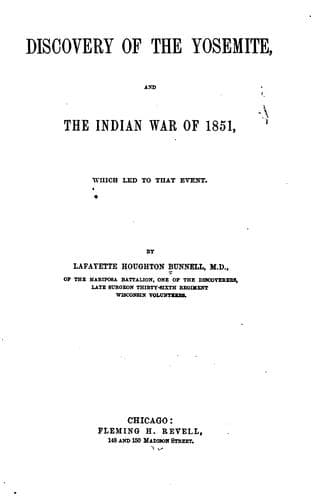
Discovery of the Yosemite, and the Indian War of 1851, Which Led to That Event — John Shaqi
Discovery of the Yosemite, and the Indian War of 1851, Which Led to That EventBunnell, Lafayette Houghton
History
Discovery of the Yosemite, and the Indian War of 1851, Which Led to That Event
Bunnell, Lafayette Houghton
Indians of North America -- California; Pacific Coast Indians, Wars with, 1847-1865; Yosemite Valley (Calif.)
Until the publication of Mr. J. M. Hutching’s book, “In The Heart of
The Sierras, Yo Semite, Big Trees, etc.,” which contains valuable
public documents, the author of “Discovery of The Yosemite” was, as
stated on page 30, unable to obtain any official records concerning the
operations of the Mariposa battalion, or of the events which preceded
and caused the Indian War of 1851. Now that Mr. Hutching’s persistent
industry has brought light from darkness, I interrupt my narrative to
make clear the origin of the war, and to justify the early Pioneers
engaged in it. As a sample, also, of many obstructions encountered, I
insert a few extracts from letters relating to the “Date of Discovery,”
furnished the _Century_ Magazine.
The attack made upon Savage on the Merced river in 1850, had for its
object plunder and intimidation, and as an invasion of Ten-ie-ya’s
territory was no longer threatened after the removal of Mr. Savage to
the Mariposa, the Yo Semities contented themselves with the theft of
horses and clothing, but a general war was still impending, as may be
seen by reference to page 31 of “In The Heart of The Sierras,” where
appears: Report of Col. Adam Johnston, a special agent, to Gov. Peter
H. Burnett, upon his return from Mariposa county to San Jose, then the
Capital of California, and which I here present: San Jose, January 2,
1851. Sir: I have the honor to submit to you, as the executive of the
State of California, some facts connected with the recent depredations
committed by the Indians, within the bounds of the State, upon the
persons and property of her citizens. The immediate scene of their
hostile movements are at and in the vicinity of the Mariposa and
Fresno. The Indians in that portion of your State have, for some time
past, exhibited disaffection and a restless feeling toward the whites.
Thefts were continually being perpetrated by them, but no act of
hostility had been committed by them on the person of any individual,
which indicated general enmity on the part of the Indians, until
the night of the 17th December last. I was then at the camp of Mr.
James D. Savage, on the Mariposa, where I had gone for the purpose of
reconciling any difficulty that might exist between the Indians and the
whites in that vicinity. From various conversations which I had held
with different chiefs, I concluded there was no immediate danger to be
apprehended. On the evening of the 17th of December, we were, however,
surprised by the sudden disappearance of the Indians. They left in a
body, but no one knew why, or where they had gone. From the fact that
Mr. Savage’s domestic Indians had forsaken him and gone with those of
the rancheria, or village, he immediately suspected that something of a
serious nature was in contemplation, or had already been committed by
them.
Public-domain text, read in full here on John Shaqi.
Reviews
Reviews
No reviews yet
Be the first to share your thoughts on this work.
Join the Discussion
Join the discussion
Sign in to leave a comment or review.
Sign InorCreate an account