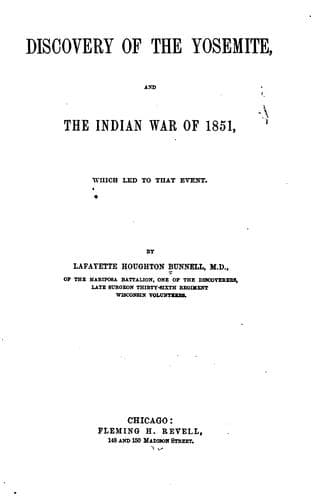
Discovery of the Yosemite, and the Indian War of 1851, Which Led to That EventBunnell, Lafayette Houghton
History
Discovery of the Yosemite, and the Indian War of 1851, Which Led to That Event
Bunnell, Lafayette Houghton
Indians of North America -- California; Pacific Coast Indians, Wars with, 1847-1865; Yosemite Valley (Calif.)
The duties of the office are anything but agreeable to an officer who
has been educated for the profession of a soldier. Few are disposed to
do the incessant drudgery required of an effective agent. As a rule,
the permanency of office, the education and _amour propre_ of military
life, raises the army officer above the temptations of the ordinary
politician; therefore, the _chances_ of an honest administration of
affairs are very much in favor of the War Department. To make that
management more effective, reasonable pay should be given competent
men, as the expenses of frontier life are usually considerable. Years
are required to comprehend and order, a practical management of people
who are, in one sense, but overgrown, vicious children. Such agents
should be retained as long as they remain honest and effective,
regardless of church or political creeds.
As the wild tribes recognize no authority but that of the
_lex-taliones_; by this law they should be governed. _Any attempt
to govern or civilize them without the power to compel obedience,
will be looked upon by barbarians with derision_, and all idea of
Christianizing _adult_ Indians, while they realize the injustice done
them by the whites, will prove impracticable. The children may be
brought under some moderate system of compulsory education and labor,
but the adults never can be. _Moral suasion_ is not comprehended as
a _power_, for the Indian’s moral qualities seem not to have been
unfolded.
The savage is naturally vain, cruel and arrogant. He boasts of his
murders and robberies, and the tortures of his victims very much in the
same manner that he recounts his deeds of valor in battle, his prowess
in killing the grizzly, and his skill in entrapping the beaver. His
treachery, is to him but cunning, his revenge a holy obligation, and
his religion but a superstitious fear. The Indians that have resorted
to labor as a means of future support, should be encouraged and
continued under the care of civilians. Their religious instruction,
like that of the whites, may safely be left to their own choice; but
for the _wild_ savage a just and humane control is necessary for their
own well-being, as well as that of the white people; for even in this
nineteenth century, life is sometimes sacrificed under some religious
delusion.
Public-domain text, read in full here on John Shaqi.
Reviews
Reviews
No reviews yet
Be the first to share your thoughts on this work.
Elsewhere in the archive
Join the Discussion
Join the discussion
Sign in to leave a comment or review.
Sign InorCreate an account