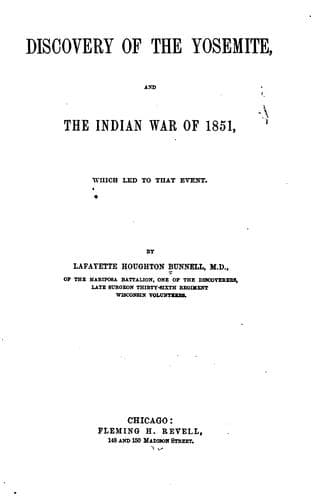
Discovery of the Yosemite, and the Indian War of 1851, Which Led to That EventBunnell, Lafayette Houghton
History
Discovery of the Yosemite, and the Indian War of 1851, Which Led to That Event
Bunnell, Lafayette Houghton
Indians of North America -- California; Pacific Coast Indians, Wars with, 1847-1865; Yosemite Valley (Calif.)
Marriage among the Indians is regarded from a business standpoint.
The preliminaries are usually arranged with the parents, guardians
and friends, by the patriarch of the family, or the chief of the
tribe. When an offer of marriage is made, the priest is consulted, he
generally designates the price to be paid for the _bride_. The squaws
of these mountain tribes are not generally voluptuous or ardent, and
notwithstanding their low and degraded condition, they were naturally
more virtuous, than has been generally supposed.
Their government being largely patriarchal, the women are subjects of
the will of the patriarch in all domestic relations. The result is,
that they have become passively submissive creatures of men’s will.
Believing this to be the natural sphere of their existence, they hold
in contempt one who performs menial labor, which they have been taught
belongs to their sex alone.
The habits of these mountain tribes being simple; their animal passions
not being stimulated by the condiments and artificial habits of
civilized life; they, in their native condition, closely resembled the
higher order of animals in pairing for offspring. The spring time is
their season of love. When the young clover blooms and the wild anise
throws its fragrance upon mountain and dell, then, in the seclusion of
the forest are formed those unions which among the civilized races are
sanctioned by the church and by the laws of the country.
[Illustration: LAKE STAR KING.]
CHAPTER XVIII.
Murder of Starkey--Death of Ten-ie-ya and Extinction of his Band--A
few Surviving Murderers--An Attempt at Reformation--A Failure and
loss of a Mule--Murders of Robert D. Sevil and Robert Smith--Alarm of
the People--A False Alarm.
During the winter of 1852-3, Jesse Starkey and Mr. Johnson, comrades of
the Mariposa battalion and expert hunters, were engaged in supplying
miners along the Mariposa Creek with venison and bear meat. They were
encamped on the head waters of the Chow-chilla and fearing no danger,
slept soundly in their encampment. They had met Indians from time to
time, who seemed friendly enough, and even the few escaped Yosemites
who recognized Starkey, showed no sign of dislike; and hence no proper
precautions were taken against their treachery.
A few days only had passed in the occupation of hunting, when a night
attack was made upon the hunters. Starkey was instantly killed, but
Johnson, though wounded, escaped to Mariposa on one of their mules.
James M. Roan, Deputy Sheriff under Captain Boling, took direction of
the wounded man, and with a posse of but 15 miners, went out to the
Chow-chilla, where they found the naked and mutilated remains of poor
Starkey, which they buried uncoffined at the camp.
Public-domain text, read in full here on John Shaqi.
Reviews
Reviews
No reviews yet
Be the first to share your thoughts on this work.
Elsewhere in the archive
Join the Discussion
Join the discussion
Sign in to leave a comment or review.
Sign InorCreate an account