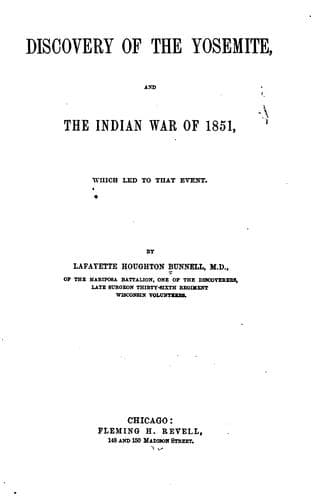
Discovery of the Yosemite, and the Indian War of 1851, Which Led to That EventBunnell, Lafayette Houghton
History
Discovery of the Yosemite, and the Indian War of 1851, Which Led to That Event
Bunnell, Lafayette Houghton
Indians of North America -- California; Pacific Coast Indians, Wars with, 1847-1865; Yosemite Valley (Calif.)
The origin of the gold found in California seems to me to have been
clearly volcanic. The varying conditions under which it is found may
be accounted for by the varying heat and force of the upheaval, the
different qualities of the matrix or quartz that carried the gold
and filled the fissures of the veins or lodes, the influence that
resistance of the inclosing walls may have exerted when it was slight
or very great, and finally the disintegrating influences of air, water,
frost and attrition of the glaciers, and the deposition in water.
The theories of aqueous deposit (in the lodes) and of electrical
action, do not satisfy my understanding, and I go back in thought to
the ten years of observation and practical experience in the gold
mines, and to the problems that were then but partially solved. Looking
at California as it is to-day, it will be conceded that its territory
has been subjected to distinct geological periods, and those periods
greatly varying in their force in different parts of the State. Within
the principal gold-bearing region of California, and especially along
the line of or near the Carson vein or lode, coarse gold has been
found, and in such large masses, free of quartz, as to force the
conviction upon the mind that the gold so found had been thrown out
_through_ and _beyond_ its matrix into a bed of volcanic ashes, very
nearly assuming the appearance that lead might assume when melted
and thrown in bulk upon an ash heap. Where the resistance was great,
as when thrown through wall rocks of gneiss, or green stone, the
liquefaction of the quartz seems to have been more complete, and the
specific gravity of the gold being so much greater than that of the
quartz, its momentum, when in large quantities, carried it out beyond
its matrix, leaving the more diffused particles to be held suspended in
the fast cooling quartz, or to settle into “pockets,” or small fissures.
Prof. Le Conte says: “The invariable association of metaliferous veins
with metamorphism demonstrates the agency of heat.” Experiments of
Daubre and others prove that water at 750° Fahr. reduces to a pasty
condition nearly all rocks. Deposits of silica in a gelatinous form,
that hardens on cooling, may be seen at some of the geysers of the
Yellowstone; the heat, no doubt, being at a great depth. Quartz, like
glass and lava, cools rapidly _externally_ when exposed to air, or
a cool surface, and would very readily hold suspended any substance
_volatilized_, or crudely mixed into its substance. Its difficult
_secondary_ fusion is no obstacle to a belief in the capacity of heat
under great pressure, to account for the phenomena that may be observed
in the gold mines. Ashes derived from lavas have been found rich in
crystalline substances. Crystals and microliths, and pyrites in cubes
are, no doubt, of volcanic origin. The eruptions of moderate character
seem to be the result of igneous fusion, while those of an explosive
type are probably aquæ-igneous.
Public-domain text, read in full here on John Shaqi.
Reviews
Reviews
No reviews yet
Be the first to share your thoughts on this work.
Elsewhere in the archive
Join the Discussion
Join the discussion
Sign in to leave a comment or review.
Sign InorCreate an account