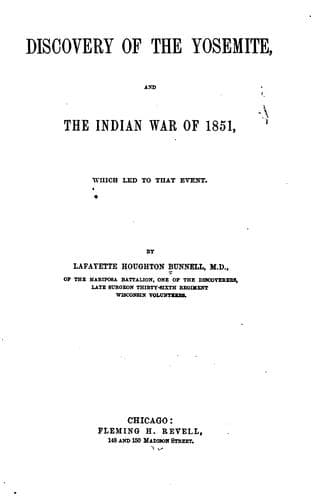
Discovery of the Yosemite, and the Indian War of 1851, Which Led to That EventBunnell, Lafayette Houghton
History
Discovery of the Yosemite, and the Indian War of 1851, Which Led to That Event
Bunnell, Lafayette Houghton
Indians of North America -- California; Pacific Coast Indians, Wars with, 1847-1865; Yosemite Valley (Calif.)
It is altogether probable from experiments tried by Stanislas Muenier
and others, that the sudden removal of pressure is a sufficient cause
of superheated water and mineral substances flashing into steam and
lava. The geysers are evidently formed by varying temperature and
interruption of flow by removal of pressure. Mr. Fanques, in an article
in the _Popular Science Monthly_ for August, 1880, says: “Discovery of
microliths enclosed in volcanic rocks is a proof of immediate formation
of crystals.”
The phenomena attending the recent eruptions in Java demonstrate the
incredible force and chemical effects of superheated steam. Modern
researches and experiments in mechanical and chemical forces have
greatly modified the views once entertained by geologists, and I think
that it will now be conceded that repeated volcanic disturbances,
taken in connection with the action of glaciers, will account for
most, if not all, the phenomena discoverable in the gold fields and
mountains of California. As a rule, gold-bearing veins in clay or
talcose slates have the gold more evenly diffused than those found in
the harder rocks, where pockets of crystals, pyrites and gold will
most likely be found. If gold is found in seams or masses it will be
very free from impurities, and the quartz itself will be most likely
white and vitreous. When gold is found in or near to a lode that has
been decomposed, it will be found porous and ragged, but if it has
been deposited some distance from its source it will be more or less
rounded and swedged by contact with the stones and gravel that were
carried with it by the stream of water or ice that conveyed it to its
placer. In the beds of the ancient and more modern rivers the gold
is much more worn than that found in the ravines or gulches, and the
coarser gold will be found at the bottom, the scale gold in the gravel
above, and the fine or flour gold in the mixture of clay, gravel and
sand nearer the surface. The scale gold, no doubt, has been beaten by
repeated blows of stones brought in contact with it while moving in the
bed of the stream, and the flour gold is that reduced by the continual
attrition of the moving mass upon the gold.
Public-domain text, read in full here on John Shaqi.
Reviews
Reviews
No reviews yet
Be the first to share your thoughts on this work.
Elsewhere in the archive
Join the Discussion
Join the discussion
Sign in to leave a comment or review.
Sign InorCreate an account