Discovery of the Yosemite, and the Indian War of 1851, Which Led to That EventBunnell, Lafayette Houghton
History
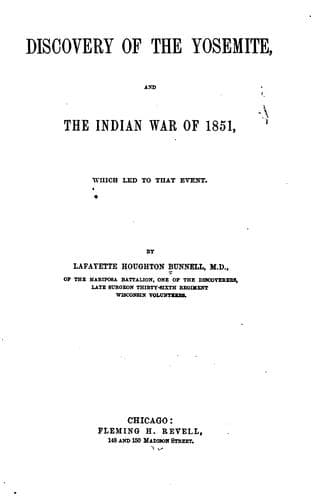
Discovery of the Yosemite, and the Indian War of 1851, Which Led to That Event
Bunnell, Lafayette Houghton
Indians of North America -- California; Pacific Coast Indians, Wars with, 1847-1865; Yosemite Valley (Calif.)
I have no doubt of the truth of this theory of formation as it relates
to the Sierra Nevada ranges as they exist to-day, for the intrusion
of the granite into the slate formations suggests a force far greater
than can be ascribed to volcanic action alone. The _previous_ condition
of the “continental mass” can not be so well imagined; yet reasoning
from what we know of the present condition of the Sierras we may with
propriety assume that great changes had occurred in the territory
embracing the Sierras Nevada long prior to their upheaval. The changes
that have occurred since are too abundant and enduring to require more
than a reference to the localities. The “glacier pavements” of the
Sierras are so conspicuous that, as Mr. John Muir says: “Even dogs and
horses gaze wonderingly at the strange brightness of the ground, and
smell it, and place their feet cautiously upon it, as if afraid of
falling or sinking.” These glacier-smoothed rocks “are simply flat or
gently undulating areas of solid granite which present the unchanged
surface upon which the ancient glaciers flowed, and are found in the
most perfect condition in the sub-alpine region, at an elevation of
from 8,000 to 9,000 feet. Some are miles in extent, only interrupted
by spots that have given way to the weather, while the best preserved
portions are bright and stainless as the sky, reflecting the sunbeams
like glass, and shining as if polished every day, notwithstanding they
have been exposed to corroding rains, dew, frost and snow for thousands
of years.”
This statement of Mr. Muir will especially apply to the “glistening
rocks” at the sources of the Merced and Tuolumne rivers, in view on
this trail through the Mono Pass. The evidences of past glacial action
in polishing the domes, mountains and valleys _above_ the Yosemite
valley, are too undeniable for controversy, but how much of the
Yosemite itself may have been produced by glacial action will probably
always remain a theme for discussion among geologists.
Prof. Samuel Kneeland, the well known author of “Wonders of the
Yosemite,” in a letter to me upon the subject, says: “I think there
can be no doubt that the valley was filled, and 1,000 feet above, by
ice--that while the _mass above_, moved, that in the valley, conforming
to its configuration, was comparatively stationary, lasting much
longer than the first, gradually melting to a lake, now represented by
the Merced river.
Public-domain text, read in full here on John Shaqi.
Reviews
Reviews
No reviews yet
Be the first to share your thoughts on this work.
Elsewhere in the archive
Join the Discussion
Join the discussion
Sign in to leave a comment or review.
Sign InorCreate an account