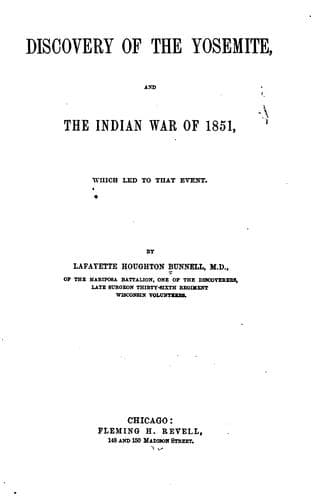
Discovery of the Yosemite, and the Indian War of 1851, Which Led to That EventBunnell, Lafayette Houghton
History
Discovery of the Yosemite, and the Indian War of 1851, Which Led to That Event
Bunnell, Lafayette Houghton
Indians of North America -- California; Pacific Coast Indians, Wars with, 1847-1865; Yosemite Valley (Calif.)
Prof. Le Conte says: “There are in many parts of California two systems
of river beds--an old and a new.... The old, or dead, river system runs
across the present drainage system in a direction far more southerly;
this is especially true of northern members of the system. Farther
south the two systems are more nearly parallel, showing less movement
in that region. These old river beds are filled with drift gravel, and
often covered with lava.” The lava referred to is relatively of modern
origin, and the molten streams have in many instances covered the
ancient streams, and in others cut them in twain. The “Blue Lead” is a
very old river bed that has been the principal source of supply of the
placer gold of the northern mines, and it must have existed as a river
long anterior to the more modern upheavals that disturbed its course
by forming mountain torrents to rend its barriers and cut across its
channel. That channel crosses some of the present tributaries of the
Sacramento and San Joaquin and contains fossil remains of trees, plants
and fruits not now indigenous to California.
The well rounded boulders and pebbles found in the beds of these
ancient rivers render it probable that they were of considerable
length, and that they may have been the channels of very ancient
glaciers. It is also probable that the region covered by glaciers
at different epochs is much more extensive than has been generally
supposed. To me it appears probable, that during some of the eras of
formation, they may have stretched across the entire continent. I have
not space to give in detail the evidences of glacial action, but will
simply state that _remains_ of glaciers may be seen by an observing
eye at intervals from the Atlantic to the Pacific; in Minnesota and
in the Rocky Mountains, they are especially abundant. Prof. Le Conte
says: “The region now occupied by the Sierra range was a marginal sea
bottom, receiving abundant sediments from a continent to the east.
At the end of the Jurassic, this line of enormously thick off-shore
deposits yielded to horizontal thrust, was crushed together and swollen
up into the Sierra range. All the ridges, peaks and canyons, all that
constitutes the grand scenery of these mountains are the result of an
almost inconceivable subsequent erosion.”
Public-domain text, read in full here on John Shaqi.
Reviews
Reviews
No reviews yet
Be the first to share your thoughts on this work.
Elsewhere in the archive
Join the Discussion
Join the discussion
Sign in to leave a comment or review.
Sign InorCreate an account