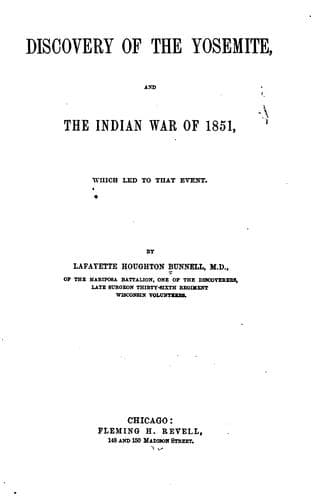
Discovery of the Yosemite, and the Indian War of 1851, Which Led to That EventBunnell, Lafayette Houghton
History
Discovery of the Yosemite, and the Indian War of 1851, Which Led to That Event
Bunnell, Lafayette Houghton
Indians of North America -- California; Pacific Coast Indians, Wars with, 1847-1865; Yosemite Valley (Calif.)
“It is only the vastness of the glacial pathways of this region that
prevents their being seen and comprehended at once. A scholar might
be puzzled with the English alphabet if it was written large enough,
and, if each letter was made up of many smaller ones. The beds of those
vast ice rivers are veiled with forests and a network of tiny water
channels. You will see by the above sketch that Yosemite was completely
overwhelmed with glaciers, and they did not come squeezing, groping
down to the main valley by the narrow, angular, tortuous canyons of
the Ten-ie-ya, Nevada or South canyons, but they flowed grandly and
directly above all of its highest domes, like a steady wind, while
their lower currents went mazing and swedging down in the crooking and
dome-blocked channels of canyons.
“Glaciers have made every mountain form of this whole region; even the
summit mountains are only fragments of their pre-glacial selves.
“Every summit wherein are laid the wombs of glaciers is steeper on
its north than its south side, because of the depth and duration
of sheltered glaciers, above those exposed to the sun, and this
steepness between the north and south sides of summits is greater in
the lower summits, as those of the Obelisk group. This tells us a
word of glacial climate. Such mountains as Starr Ring, Cloud’s Rest,
and Cathedral Peak do not come under this general law because their
contours were determined by the ice which flowed about and above them,
but even among these inter-basin heights we frequently find marked
difference of steepness between their north and south sides, because
many of the higher of these mountains and crests extending east and
west, continued to shelter and nourish fragmentary glacierets long
after the death of the main trunk to which they belonged.
“In ascending any of the principal streams of this region, lakes in
all stages of decay are found in great abundance, gradually becoming
younger until we reach the almost countless gems of the summits
with basins bright as their crystal waters. Upon the Nevada and its
branches, there are not fewer than a hundred of these lakes, from a
mile to a hundred yards in diameter, with countless glistening pondlets
about the size of moons. Both the Yosemite and the Hetch-Hetchy valleys
are lake basins filled with sand and the matter of morains easily and
rapidly supplied by their swift descending rivers from upper morains.
The mountains above Yosemite have scarce been touched by any other
denudation but that of ice. Perhaps all of the post glacial denudation
of every kind would not average an inch in depth for the whole region.
Public-domain text, read in full here on John Shaqi.
Reviews
Reviews
No reviews yet
Be the first to share your thoughts on this work.
Elsewhere in the archive
Join the Discussion
Join the discussion
Sign in to leave a comment or review.
Sign InorCreate an account