Discovery of the Yosemite, and the Indian War of 1851, Which Led to That EventBunnell, Lafayette Houghton
History
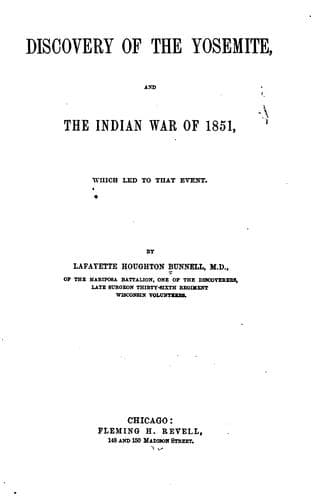
Discovery of the Yosemite, and the Indian War of 1851, Which Led to That Event
Bunnell, Lafayette Houghton
Indians of North America -- California; Pacific Coast Indians, Wars with, 1847-1865; Yosemite Valley (Calif.)
“I am surprised to find that water has had so little to do with the
mountain structure of this region. None of the upper Merced streams
give record of floods greater than those of to-day. The small water
channel, with perpendicular walls, is about two feet in depth a few
miles above the Little Yosemite. The Nevada here, even in flood, never
was more than four or five feet in depth. Glacial striæ and glacial
drift, undisturbed on banks of streams but little above the present
line of high water mark, is sufficient proof.”
The views entertained by Mr. Muir are, for the most part, in consonance
with my own. That the valley was originally formed as supposed by
Prof. Whitney I do not doubt, but to suppose that the vast bodies
of ice, stated by Mr. Whitney to have existed at the sources of
the Merced river, could have halted in their glacial flow down the
steep declivities of its canyons, seems as absurd as to suppose one
entertaining opposite views “ignorant of the whole subject.” As a
matter susceptible of eternal proof, I will state that in the canyon
below the Yosemite there are existing to-day, large, well rounded
bowlders that I think a geologist would say had been brought from above
the valley; and if so, water alone could scarcely have brought them
over the sunken bed of the valley, or if filled to its present level
of about thirty-five feet descent to the mile, the laws that govern
aqueous deposits would have left those huge masses of rock far above
their present location in the canyon. Some of the bowlders referred
to will weigh twenty tons or more, and, in connection with flat or
partially rounded rocks fallen, probably, from the adjacent cliff, form
waterfalls in the middle of the canyon, of from fifty to one hundred
feet of perpendicular height. The fall through the canyon averages over
two hundred feet to the mile. Well rounded bowlders of granite and
other hard stones may be seen for long distances below the Yosemite,
on hillsides and flats far above the present bed of the river, and, in
some instances, deposited with those bowlders, have been found well
rounded and swedged masses of gold. The experiments and observations
of Agassiz, Forbes and others, render it probable that the valley of
the Yosemite was filled with ice, but that the upper surface moved more
rapidly, carrying down most of the material brought from mountains
above the valley. The observations of Prof. Tyndall render it almost
certain that a glacier does not move as a rigid mass or on its bed, but
as a plastic substance, as asphalt for instance.
Public-domain text, read in full here on John Shaqi.
Reviews
Reviews
No reviews yet
Be the first to share your thoughts on this work.
Elsewhere in the archive
Join the Discussion
Join the discussion
Sign in to leave a comment or review.
Sign InorCreate an account