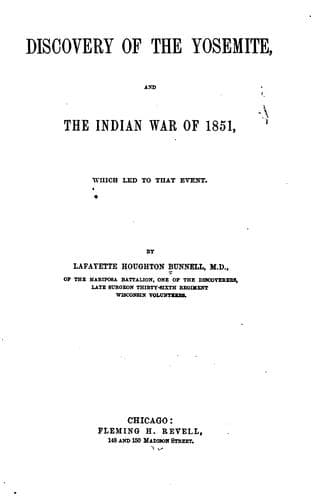
Discovery of the Yosemite, and the Indian War of 1851, Which Led to That EventBunnell, Lafayette Houghton
History
Discovery of the Yosemite, and the Indian War of 1851, Which Led to That Event
Bunnell, Lafayette Houghton
Indians of North America -- California; Pacific Coast Indians, Wars with, 1847-1865; Yosemite Valley (Calif.)
The whole body of Indians seemed bent on killing Mr. Savage, partly
because he would not be their chief and lead them against the whites,
and partly because he was, they knew, our greatest dependence as guide,
and their particular dread. To kill him, many of them sacrificed their
own lives. They would come one at a time and, standing in open ground,
send arrows at him until shot down; and one old chief who used to cook
for Savage, would ask him after every shot where he had hit him. They
would talk to him to find out where he was, and as soon as he would
answer, the balls and arrows would fly thick around his head: but he
escaped unhurt; but as he said, worse frightened than he ever was
before. He did not fancy such partiality.
A large party has started on a second expedition, but I believe I am
perfectly satisfied with Indian fighting.
T. G. PALMER.
NOTE.--It will have been observed that especial reference has twice
been made to Gim-o-sell brush, a shrub that grows only on warm slatey
soil, on Southern exposures, sought by Indians for winter quarters,
and not on the granite cliffs and mountains of the Yosemite. I had
not thought it necessary to draw upon nature for testimony, but a new
generation has sprung into existence, and the eternal hills may speak
to them.
The mining camp or village of Agua Fria, at the date of the
organization of the battalion, was the county seat of Mariposa County,
and the residence of the Sheriff, Major James Burney. Whittier’s
Hotel was the head-quarters for enlistment. Finding the number called
for incomplete, while yet in daily expectation of the arrival of the
mustering officer, James D. Savage made a rapid ride to the San Joaquin
diggings, and returned with men enough to complete the organization.
We were formally reported for duty, and went into camp about two miles
below Agua Fria, on about the 10th of Feb., 1851, but when mustered
in, the rolls were dated to include service from Jan. 24th, 1851, the
date of the last order of enlistment. An informal ballot was taken to
show the preference of the men for officers to command us, Major Burney
having previously declined, and when that had been demonstrated, other
aspirants were withdrawn by their friends, a formal ballot was taken
and a regular organization of three companies completed. The Governor
was duly notified of our proceedings, and in a few days the commissions
were received by our respective officers.
After a few days in camp on Agua Fria Creek, we moved down to a camp in
the foot hills, known afterwards as Lewis Ranch, where we had abundant
grass and good water, and there was established our head-quarters,
while waiting for Col. J. Neely Johnson and the U. S. Indian
Commission, as stated in this chapter.
Public-domain text, read in full here on John Shaqi.
Reviews
Reviews
No reviews yet
Be the first to share your thoughts on this work.
Join the Discussion
Join the discussion
Sign in to leave a comment or review.
Sign InorCreate an account