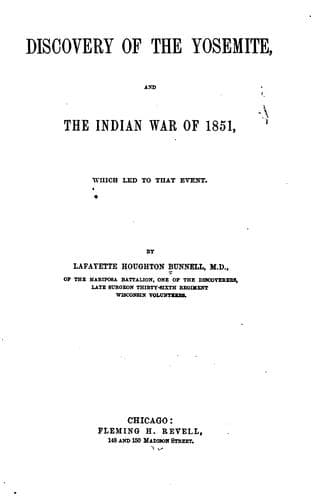
Discovery of the Yosemite, and the Indian War of 1851, Which Led to That EventBunnell, Lafayette Houghton
History
Discovery of the Yosemite, and the Indian War of 1851, Which Led to That Event
Bunnell, Lafayette Houghton
Indians of North America -- California; Pacific Coast Indians, Wars with, 1847-1865; Yosemite Valley (Calif.)
Major Savage soon came, but could elicit nothing of importance from
her. When asked where her companions were, she understood the dialect
used, for she very curtly replied “You can hunt for them if you want
to see them”! When asked why she was left alone, she replied “I am
too old to climb the rocks”! The Major--forgetting the gallantry
due her sex--inquired “How old are you?” With an ineffably scornful
grunt, and a coquettish leer at the Major, she maintained an indignant
silence. This attempt at a smile, left the Major in doubt as to her
age. Subsequently, when Ten-ie-ya was interrogated as to the age
of this old squaw, he replied that “No one knows her age. That when
he was a boy, it was a favorite _tradition_ of the _old_ members of
his band, that when she was a child, the peaks of the Sierras were
but little hills.” This free interpretation was given by the Major,
while seated around the camp fire at night. If not _reliable_, it was
excessively amusing to the “Boys,” and added to the Major’s popularity.
On a subsequent visit to the Valley, an attempt was made to send the
old creature to the commissioner’s camp; she was placed on a mule and
started. As she could not bear the fatigue, she was left with another
squaw. We learned that she soon after departed “to _the happy land in
the West_.”
The detachment sent down the trail reported the discovery of a small
rancheria, a short distance above the “Cathedral Rocks,” but the huts
were unoccupied. They also reported the continuance of the trail down
the left bank. The other detachments found huts in groups, but no
Indians. At all of these localities the stores of food were abundant.
Their _cachés_ were principally of acorns, although many contained
bay (California laurel), Piñon pine (Digger pine), and chinquepin
nuts, grass seeds, wild rye or oats (scorched), dried worms, scorched
grasshoppers, and what proved to be the dried larvæ of insects, which
I was afterwards told were gathered from the waters of the lakes in
and east of the Sierra Nevada. It was by this time quite clear that
a large number of Ten-ie-ya’s band was hidden in the cliffs or among
the rocky gorges or cañons, not accessible to us from the knowledge
we then had of their trails and passes. We had not the time, nor had
we supplied ourselves sufficiently to hunt them out. It was therefore
decided that the best policy was to destroy their huts and stores, with
a view of starving them out, and of thus compelling then to come in and
join with Ten-ie-ya and the people with him on the reservation. At this
conclusion the destruction of their property was ordered, and at once
commenced. While this work was in progress, I indulged my curiosity
in examining the lodges in which had been left their home property,
domestic, useful and ornamental. As compared with eastern tribes, their
supplies of furniture of all kinds, excepting baskets, were meagre
enough.
Public-domain text, read in full here on John Shaqi.
Reviews
Reviews
No reviews yet
Be the first to share your thoughts on this work.
Elsewhere in the archive
Join the Discussion
Join the discussion
Sign in to leave a comment or review.
Sign InorCreate an account