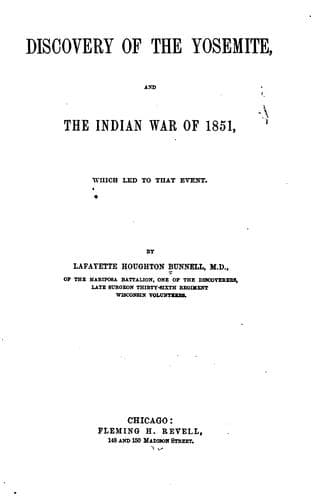
Discovery of the Yosemite, and the Indian War of 1851, Which Led to That EventBunnell, Lafayette Houghton
History
Discovery of the Yosemite, and the Indian War of 1851, Which Led to That Event
Bunnell, Lafayette Houghton
Indians of North America -- California; Pacific Coast Indians, Wars with, 1847-1865; Yosemite Valley (Calif.)
These baskets were quite numerous, and were of various patterns and
for different uses. The large ones were made either of bark, roots of
the Tamarach or Cedar, Willow or Tule. Those made for gathering and
transporting food supplies, were of large size and round form, with
a sharp apex, into which, when inverted and placed upon the back,
everything centres. This form of basket enables the carriers to keep
their balance while passing over seemingly impassable rocks, and along
the verge of dangerous precipices. Other baskets found served as water
buckets. Others again of various sizes were used as cups and soup
bowls; and still another kind, made of a tough, wiry grass, closely
woven and cemented, was used for kettles for boiling food. The boiling
was effected by hot stones being continually plunged into the liquid
mass, until the desired result was obtained.
The water baskets were also made of “wire-grass;” being porous,
evaporation is facilitated, and like the porous earthen water-jars of
Mexico, and other hot countries, the water put into them is kept cool
by evaporation. There were also found at some of the encampments, robes
or blankets made from rabbit and squirrel skins, and from skins of
water-fowl. There were also ornaments and musical instruments of a rude
character. The instruments were drums and flageolets. The ornaments
were of bone, bears’ claws, birds’ bills and feathers. The thread used
by these Indians, I found was spun or twisted from the inner bark of
a species of the asclepias or milk-weed, by ingeniously suspending a
stone to the fibre, and whirling it with great rapidity. Sinews are
chiefly used for sewing skins, for covering their bows and feathering
their arrows. Their fish spears were but a single tine of bone, with a
cord so attached near the centre, that when the spear, loosely placed
in a socket in the pole, was pulled out by the struggles of the fish,
the tine and cord would hold it as securely as though held by a barbed
hook.
There were many things found that only an Indian could possibly use,
and which it would be useless for me to attempt to describe; such,
for instance, as stag-horn hammers, deer prong punches (for making
arrow-heads), obsidian, pumice-stone and salt brought from the eastern
slope of the Sierras and from the desert lakes. In the hurry of their
departure they had left everything. The numerous bones of animals
scattered about the camps, indicated their love of horse-flesh as a
diet.
Among these relics could be distinguished the bones of horses and
mules, as well as other animals, eaten by these savages. Deers and
bears were frequently driven into the valley during their seasons
of migration, and were killed by expert hunters perched upon rocks
and in trees that commanded their runways or trails; but their chief
dependence for meat was upon horseflesh.
Public-domain text, read in full here on John Shaqi.
Reviews
Reviews
No reviews yet
Be the first to share your thoughts on this work.
Elsewhere in the archive
Join the Discussion
Join the discussion
Sign in to leave a comment or review.
Sign InorCreate an account