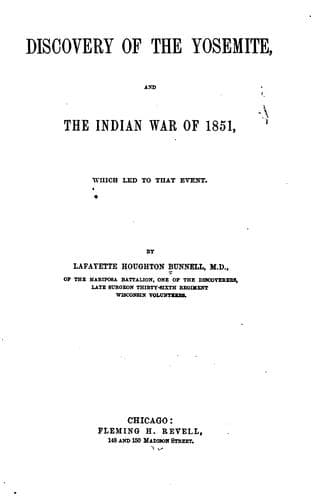
Discovery of the Yosemite, and the Indian War of 1851, Which Led to That EventBunnell, Lafayette Houghton
History
Discovery of the Yosemite, and the Indian War of 1851, Which Led to That Event
Bunnell, Lafayette Houghton
Indians of North America -- California; Pacific Coast Indians, Wars with, 1847-1865; Yosemite Valley (Calif.)
Notwithstanding a little warmth of discussion, we cheerfully wrapped
ourselves in our blankets and slept, until awakened by the guard; for
there had been no disturbance during the night. The snow had fallen
only to about the depth of an inch in the valley, but the storm still
continued.
By early dawn “all ready” was announced, and we started back without
having seen any of the Indian race except our useless guide and the
old squaw. Major Savage rode at the head of the column, retracing our
trail, rather than attempt to follow down the south side. The water was
relatively low in the early morning, and the fords were passed without
difficulty. While passing El Capitan I felt like saluting, as I would
some dignified acquaintance.
The _cachés_ below were yet smouldering, but the lodges had disappeared.
At our entrance we had closely followed the Indian trail over rocks
that could not be re-ascended with animals. To return, we were
compelled to remove a few obstructions of poles, brush and loose rocks,
placed by the Indians to prevent the escape of the animals stolen and
driven down. Entire herds had been sometimes taken from the ranches or
their ranges.
After leaving the valley, but little difficulty was encountered. The
snow had drifted into the hollows, but had not to any extent obscured
the trail, which we now found quite hard. We reached the camp earlier
in the day than we had reason to expect. During these three days of
absence from headquarters, we had discovered, named and partially
explored one of the most remarkable of the geographical wonders of the
world.
CHAPTER VI.
Out of Provisions--A hurried Move--Mills where Indians take Their
Grists, and Pots in which they Boil their Food--Advance Movement of
Captain Dill--A Hungry Squad--Enjoyment--Neglect of Duty--Escape
of Indians--Following their Trail--A Sorrowful Captain--A Mystery
made Clear--Duplicity of the Chow-chillas--Vow-chester’s Good-will
Offering--Return of the Fugitives--Major Savage as Agent and
Interpreter.
On our arrival at the rendezvous on the South Fork the officer in
charge reported; “We are about out of grub.” This was a satisfactory
cause for a hurried movement; for a short allowance had more terrors
for men with our appetites than severe duties; and most of us had
already learned that, even with prejudice laid aside, our stomachs
would refuse the hospitalities of the Indians, if it were possible
for them to share with us from their own scanty stores. The Major’s
experience prompted him at once to give the order to break camp and
move on for the camp on the Fresno.
Our mounted force chafed at the slowness of our march; for the Indians
could not be hurried. Although their cookery was of the most primitive
character, we were very much delayed by the time consumed in preparing
their food.
Public-domain text, read in full here on John Shaqi.
Reviews
Reviews
No reviews yet
Be the first to share your thoughts on this work.
Elsewhere in the archive
Join the Discussion
Join the discussion
Sign in to leave a comment or review.
Sign InorCreate an account