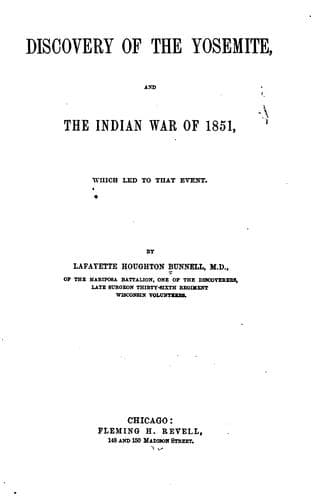
Discovery of the Yosemite, and the Indian War of 1851, Which Led to That EventBunnell, Lafayette Houghton
History
Discovery of the Yosemite, and the Indian War of 1851, Which Led to That Event
Bunnell, Lafayette Houghton
Indians of North America -- California; Pacific Coast Indians, Wars with, 1847-1865; Yosemite Valley (Calif.)
While traveling we were compelled to accommodate our movements to the
capacities or inclinations of the women and children. Captain Dill,
therefore, with his company was sent on ahead from the crossing of the
South Fork, they leaving with us what food they could spare. When Dill
reached the waters of the Fresno about one hundred “_captives_” joined
him. These Indians voluntarily surrendered to Captain Dill’s company,
which at once hurried them on, and they reached the commissioners at
the Fresno.
Captain Boling’s company and Major Savage remained with the “Grand
Caravan,” keeping out scouts and hunters to secure such game as might
be found to supply ourselves with food. We had no anxiety for the
safety or security of our “captives;” our own subsistence was the
important consideration; for the first night out from Bishop’s camp
left us but scanty stores for breakfast. Our halting places were
selected from the old Indian camping grounds, which were supplied
with hoyas (holes or mortars). These permanent mortars were in the
bed-rock, or in large detached rocks that had fallen from the cliffs or
mountains. These “hoyas” had been formed and used by past generations.
They were frequent on our route, many of them had long been abandoned;
as there was no indications of recent uses having been made of them.
From their numbers it was believed that the Indians had once been much
more numerous than at that date.
By means of the stone pestles with which they were provided, the squaws
used these primitive mills to reduce their acorns and grass seeds to
flour or meal. While the grists were being ground, others built the
fires on which stones were heated.
When red hot, these stones were plunged into baskets nearly filled
with water; this is continued until the water boils. The stones are
then removed and the acorn meal, or a cold mixture of it, is stirred
in until thin gruel is made; the hot stones are again plunged into
the liquid mass and again removed. When sufficiently cooked, this
“Atola” or porridge, was poured into plates or moulds of sand, prepared
for that purpose. During the process of cooling, the excess of
water leaches off through the sand, leaving the woody fibre tannin
and unappropriated coarse meal in distinctive strata; the edible
portion being so defined as to be easily separated from the refuse
and sand. This preparation was highly prized by them, and contrary to
preconceived ideas and information, all of the Indians I asked assured
me that the _bitter_ acorns were the best when cooked. This compound
of acorn meal resembles corn starch blanc mange in color, but is more
dense in consistency. Although it was free from grit, and comparatively
clean, none of us were able to eat it, and we were quite hungry. From
this, I was led to conclude that to relish this Indian staple, the
taste must be acquired while very young.
Public-domain text, read in full here on John Shaqi.
Reviews
Reviews
No reviews yet
Be the first to share your thoughts on this work.
Elsewhere in the archive
Join the Discussion
Join the discussion
Sign in to leave a comment or review.
Sign InorCreate an account