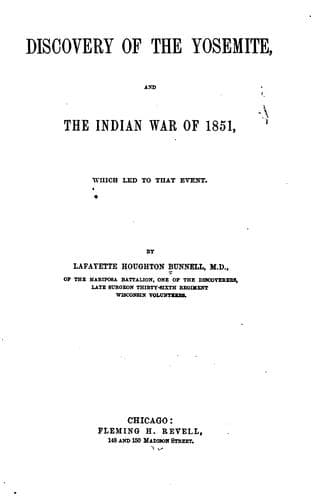
Discovery of the Yosemite, and the Indian War of 1851, Which Led to That EventBunnell, Lafayette Houghton
History
Discovery of the Yosemite, and the Indian War of 1851, Which Led to That Event
Bunnell, Lafayette Houghton
Indians of North America -- California; Pacific Coast Indians, Wars with, 1847-1865; Yosemite Valley (Calif.)
My recollections of those early days are from personal observations
and information derived from the earlier settlers of the San Joaquin
valley, with whom I was personally acquainted in the mining camps, and
through business connections; and also from comrades in the Indian war
of 1850-51. Among these settlers was one James D. Savage, a trader,
who in 1849-50 was located in the mountains near the mouth of the South
Fork of the Merced river, some fifteen miles below the Yosemite valley.
At this point, engaged in gold mining, he had employed a party of
native Indians. Early in the season of 1850 his trading post and mining
camp were attacked by a band of the Yosemite Indians. This tribe,
or band, claimed the territory in that vicinity, and attempted to
drive Savage off. Their real object, however, was plunder. They were
considered treacherous and dangerous, and were very troublesome to the
miners generally.
Savage and his Indian miners repulsed the attack and drove off the
marauders, but from this occurrence he no longer deemed this location
desirable. Being fully aware of the murderous propensities of his
assailants, he removed to Mariposa Creek, not far from the junction
of the Agua Fria, and near to the site of the old stone fort. Soon
after, he established a branch post on the Fresno, where the mining
prospects became most encouraging, as the high water subsided in that
stream. This branch station was placed in charge of a man by the name
of Greeley.
At these establishments Savage soon built up a prosperous business. He
exchanged his goods at enormous profits for the gold obtained from his
Indian miners. The white miners and prospecting parties also submitted
to his demands rather than lose time by going to Mariposa village. The
value of his patrons’ time was thus made a source of revenue. As the
season advanced, this hardy pioneer of commerce rapidly increased his
wealth, but in the midst of renewed prosperity he learned that another
cloud was gathering over him. One of his five squaws assured him that
a combination was maturing among the mountain Indians, to kill or
drive all the white men from the country, and plunder them of their
property. To strengthen his influence over the principal tribes, Savage
had, according to the custom of many mountain men, taken wives from
among them, supposing his personal safety would be somewhat improved by
so doing. This is the old story of the prosperous Indian trader. Rumor
also came from his Indian miners, that the Yosemites threatened to come
down on him again for the purpose of plunder, and that they were urging
other tribes to join them.
These reports he affected to disregard, but quietly cautioned the
miners to guard against marauders.
He also sent word to the leading men in the settlements that
hostilities were threatened, and advised preparations against a
surprise.
Public-domain text, read in full here on John Shaqi.
Reviews
Reviews
No reviews yet
Be the first to share your thoughts on this work.
Join the Discussion
Join the discussion
Sign in to leave a comment or review.
Sign InorCreate an account