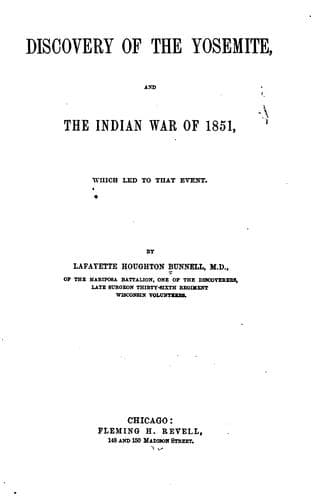
Discovery of the Yosemite, and the Indian War of 1851, Which Led to That EventBunnell, Lafayette Houghton
History
Discovery of the Yosemite, and the Indian War of 1851, Which Led to That Event
Bunnell, Lafayette Houghton
Indians of North America -- California; Pacific Coast Indians, Wars with, 1847-1865; Yosemite Valley (Calif.)
The Captain said: “Soon after you left us last night, one of my men,
who was out hunting when we camped, came in with a deer he had killed
just at the dusk of the evening. From this we made a hearty supper,
and allowed the youth who had helped to bring in the deer to share
in the meat. The Indian cooked the part given to him at our fire,
and ate with the avidity of a famished wolf. This excited comment,
and anecdotes followed of the enormous appetites displayed by some
of them. The question was then raised, ‘how much can this Indian eat
at one meal?’ I suggested that a fair trial could not be had with
only one deer. Our hunter said he would give him a preliminary trial,
and when deer were plenty we could then test his full capacity, if
he should prove a safe one to bet on. He then cut such pieces as we
thought would suffice for our breakfast, and, with my approval, gave
the remainder to his boy, who was anxiously watching his movements. I
consented to this arrangement, not as a test of his capacity, for I
had often seen a hungry Indian eat, but as a reward for his services
in bringing in the deer on his shoulders. He readily re-commenced his
supper, and continued to feast until every bone was cracked and picked.
When the last morsel of the venison had disappeared he commenced a
doleful sing-song, ‘Way-ah-we-ha-ha, Wah-ah-we-ha-ha’ to some unknown
deity, or, if I was to judge from my ear of the music, it must have
been his prayer to the devil, for I have heard that it is a part of
their worship. His song was soon echoed from the camp where all seemed
contentment. After _consoling_ himself in this manner for some time he
fell asleep at our fire.
“The performance being over, I told my men to take their sleep and
I would watch, as I was not sleepy; if I wanted them I would call
them. I then thought, as Major Savage had declared, the Indians could
scarcely be driven off, until they had had their feast and the presents
they expected to have given them. I sat by the fire for a long time
cogitating on past events and future prospects, when thinking it
useless to require the men to stand guard, I told them to sleep. Moving
about and seeing nothing but the usual appearance, I decided it to be
unneccessary to exercise any further vigilance, and told one of the
men, who was partially aroused by my movements, and who offered to get
up and stand guard, that he had better lie still and sleep. Toward
morning I took another round, and finding the Indian camp wrapped in
apparently profound slumber, I concluded to take a little sleep myself,
until daylight. This now seems unaccountable to me, for I am extremely
cautious in my habits. Such a breach of military discipline would have
subjected one of my men to a court-martial. I confess myself guilty of
neglect of duty; I should have taken nothing for granted.
Public-domain text, read in full here on John Shaqi.
Reviews
Reviews
No reviews yet
Be the first to share your thoughts on this work.
Elsewhere in the archive
Join the Discussion
Join the discussion
Sign in to leave a comment or review.
Sign InorCreate an account