Discovery of the Yosemite, and the Indian War of 1851, Which Led to That EventBunnell, Lafayette Houghton
History
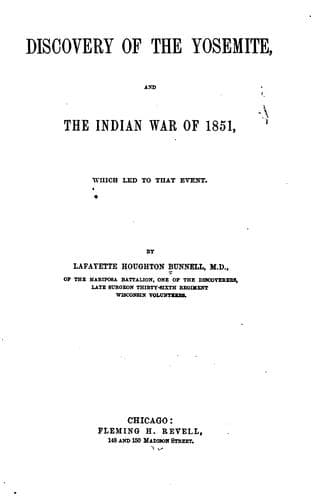
Discovery of the Yosemite, and the Indian War of 1851, Which Led to That Event
Bunnell, Lafayette Houghton
Indians of North America -- California; Pacific Coast Indians, Wars with, 1847-1865; Yosemite Valley (Calif.)
“No one can imagine my surprise and mortification when I was called and
told that the Indian camp was entirely deserted, and that none were
to be seen except the one asleep by our camp fire. My indifference to
placing a guard over the Indian camp will probably always be a mystery
to me, but it most likely saved our lives, for if we had attempted to
restrain them, and you know us well enough to believe we would not have
let them off without a fight; they would probably have pretty well used
us up. As it was, we did not give them up without an effort. We saddled
our horses and started in chase, thinking that as while with us, their
women and children would retard their progress, and that we would soon
overtake them. We took the young brave with us, who had slept by our
fire. He knew nothing of the departure of his people, and was very much
alarmed, as he expected we would at once kill him. I tried to make him
useful in following their trail; he by signs, gave me to understand
he did not know where they had gone, and seemed unwilling to take the
trail when I pointed it out to him. He evidently meant to escape the
first opportunity. I kept him near me and treated him kindly, but gave
him to understand I should shoot him if he tried to leave me.
“We pursued until the trail showed that they had scattered in every
direction in the brushy ravines and on the rocky side of a mountain
covered with undergrowth, where we could not follow them with our
animals. Chagrined and disgusted with myself for my negligence, and my
inability to recover any part of my charge, and considering farther
pursuit useless, we turned about and took the trail to head-quarters
with our one captive.”
Major Savage took the youngster under his charge, and flattered him by
his conversations and kindly treatment. The Commissioners lionized him
somewhat; he was gaily clothed and ornamented, loaded with presents
for his own family relations, and was given his liberty and permitted
to leave camp at his leisure, and thus departed the last of the “grand
caravan” of some three hundred and fifty “captives,” men, women and
children, which we had collected and escorted from the mountains.
The sight of the one hundred brought to them by Captain Dill, and his
report that we were coming with about three hundred and fifty more,
aroused sanguine hopes in the commission that the war was over, and
that their plans had been successful. “Now that the _prisoners_ have
fled,” we asked, “What will be done?”
Public-domain text, read in full here on John Shaqi.
Reviews
Reviews
No reviews yet
Be the first to share your thoughts on this work.
Elsewhere in the archive
Join the Discussion
Join the discussion
Sign in to leave a comment or review.
Sign InorCreate an account