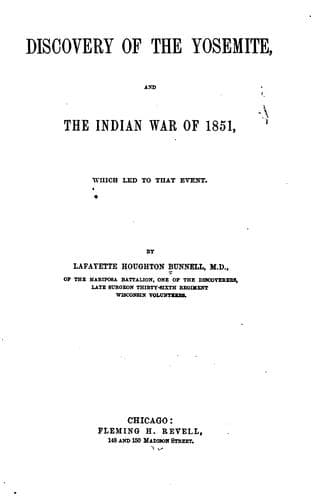
Discovery of the Yosemite, and the Indian War of 1851, Which Led to That EventBunnell, Lafayette Houghton
History
Discovery of the Yosemite, and the Indian War of 1851, Which Led to That Event
Bunnell, Lafayette Houghton
Indians of North America -- California; Pacific Coast Indians, Wars with, 1847-1865; Yosemite Valley (Calif.)
I saw but little of interest, for at the time, I doubted the antiquity
of the figures. Subsequently, in conversation with Major Savage he said
that the figures had probably been traced by ancient Indians, as the
present tribes had no knowledge of the representations. I afterwards
asked Sandino and other Mission Indians concerning them, but none
could give me any information. The scouts sent out were instructed to
rendezvous near a double fall on the north fork of the San Joaquin in a
little valley through which the trail led connecting with that of the
north fork, as grass would there be found abundant.
Major Savage was familiar with most of the permanent trails in this
region, as he had traversed it in his former prospecting tours. As we
entered the valley selected for our camping place, a flock of sand-hill
cranes rose from it with their usual persistent yells; and from this
incident, their name was affixed to the valley, and is the name by
which it is now known.
The scouts, who were watching on the trail below, soon discovered and
joined us. “It is a little early for camping,” the Major said; “but at
this season, good grass can only be found in the mountains in certain
localities. Here there is an abundance, and soap root enough to wash a
regiment.”
We fixed our camp on the West side of the little valley, about half
a mile from the double falls. These falls had nothing peculiarly
attractive, except as a designated point for a rendezvous.
The stream above the falls was narrow and very rapid, but below, it ran
placidly for some distance through rich meadow land. The singularity
of the fall was in its being double; the upper one only three or four
feet, and the lower one, which was but a step below, about ten or
twelve feet. In my examination of the locality, I was impressed with
the convenience with which such a water-power could be utilized for
mechanical purposes, if the supply of water would but prove a permanent
one.
From this camp, new scouts were sent out in search of Indians and their
trails; while a few of us had permission to hunt within a mile of camp.
While picketing our animals, I observed the flock of sand-hill cranes
again settling down some way above us, and started with Wm. Hays to get
a shot at them. We were not successful in getting within range; having
been so recently alarmed, they were suspiciously on the look out, and
scenting our approach, they left the valley. Turning to the eastward,
we were about entering a small ravine leading to the wooded ridge on
the Northwest side of the Fork, when we discovered two deer ascending
the slope, and with evident intention of passing through the depression
in the ridge before us.
Public-domain text, read in full here on John Shaqi.
Reviews
Reviews
No reviews yet
Be the first to share your thoughts on this work.
Elsewhere in the archive
Join the Discussion
Join the discussion
Sign in to leave a comment or review.
Sign InorCreate an account