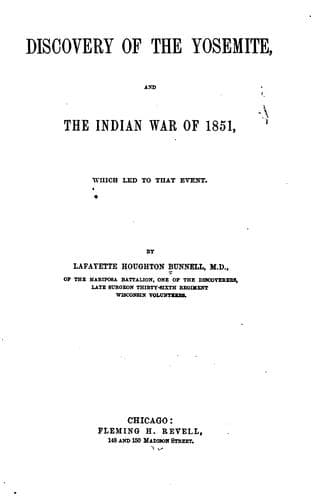
Discovery of the Yosemite, and the Indian War of 1851, Which Led to That EventBunnell, Lafayette Houghton
History
Discovery of the Yosemite, and the Indian War of 1851, Which Led to That Event
Bunnell, Lafayette Houghton
Indians of North America -- California; Pacific Coast Indians, Wars with, 1847-1865; Yosemite Valley (Calif.)
They were looking _back_ on their trail, assurance enough that we had
not been seen. We hurriedly crept up the ravine to head them off,
and waited for their approach. Hays became nervous, and as he caught
a glimpse of the leader, he hastily said, “Here they come--both of
them--I’ll take the buck!” Assenting to his arrangement, we both fired
as they rose in full view. The doe fell almost in her tracks. The
buck made a bound or two up the ridge and disappeared. While loading
our rifles Hays exclaimed, as if in disgust, “A miss, by jingoes!
that’s a fact.” I replied, “not so, old fellow, you hit him hard; he
switched his tail desperately; you will see him again.” We found him
dead in the head of the next ravine, but a few rods off. Hanging up
our game to secure it until our return with horses, we started along
the slope of the ridge toward camp. Hays was in advance, stopping
suddenly, he pointed to some immense tracks of grizzlies, which in the
soft, yielding soil appeared like the foot prints of huge elephants,
and then hastily examining his rifle and putting a loose ball in his
mouth (we had no fixed ammunition in those days, except the old paper
cartridges), started on the tracks. At first I was amused at his
excited, silent preparations and rapid step, and passively accompanied
him. When we had reached a dense under-growth, into which the trail
led, and which he was about to enter, I halted and said: “I have
followed this trail as far as I design to go. Hays, it is madness for
us to follow grizzlies into such a place as that.” Hays turned, came
back, and said in an excited manner, “I didn’t suppose you would show
the white feather with a good rifle in your hands; Chandler gives you
a different character. You don’t mean to say you are afraid to go in
there with me; we’ll get one or two, sure.”
I was at first inclined to be angry, but replied, “Hays, I am much
obliged to you for the good opinion you have had of me, but I know what
grizzlies are. _I am afraid of grizzlies unless I have every advantage
of them_; and don’t think it would be any proof of courage to follow
them in there.” Hays reached out his hand as he said: “If that is
your corner stake, we will go back to camp.” We shook hands, and that
question was settled between us. Afterwards Hays told of his experience
among Polar bears, and I rehearsed some of mine among cinnamon and
grizzly bears, and he replied that after all he thought “we had acted
wisely in letting the latter remain undisturbed. When in the brush they
seemed to know their advantage, and were more likely to attack, whereas
at other times, they would get out of your way, if they could.” I
replied by asking: “Since you know their nature so well, why did you
want to follow them into the brush?” He retorted, “Simply because I was
excited and reckless, like many another man.”
Public-domain text, read in full here on John Shaqi.
Reviews
Reviews
No reviews yet
Be the first to share your thoughts on this work.
Elsewhere in the archive
Join the Discussion
Join the discussion
Sign in to leave a comment or review.
Sign InorCreate an account