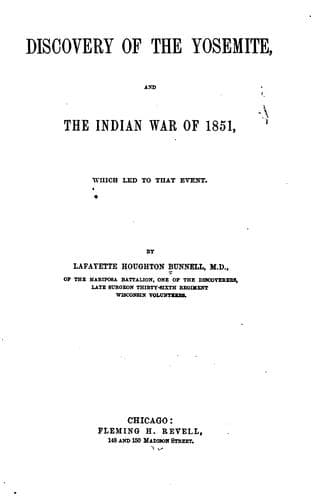
Discovery of the Yosemite, and the Indian War of 1851, Which Led to That EventBunnell, Lafayette Houghton
History
Discovery of the Yosemite, and the Indian War of 1851, Which Led to That Event
Bunnell, Lafayette Houghton
Indians of North America -- California; Pacific Coast Indians, Wars with, 1847-1865; Yosemite Valley (Calif.)
Taking the back trail, we soon reached camp, and with our horses
brought in the game before dark. While entering camp, several of our
men rushed by with their rifles. Looking back across the open valley on
our own trail, I saw a man running toward us as if his life depended
on his speed. His long hair was fairly streaming behind as he rushed
breathless into camp, without hat, shoes or gun. When first seen,
the “boys” supposed the Chow-chillas were after him, but no pursuers
appeared in sight. As soon as he was able to talk, he reported that
he had left the squad of hunters he had gone out with, and was moving
along the edge of a thicket on his way to camp, when he struck the
trail of three grizzlies. Having no desire to encounter them, he left
their trail, but suddenly came upon them while endeavoring to get out
of the brush.
Before he could raise his rifle, they rushed toward him. He threw his
hat at the one nearest, and started off at a lively gait. Glancing
back, he saw two of them quarreling over his old hat; the other was so
close that he dare not shoot, but dropped his gun and ran for life.
Fortunately, one of his shoes came off, and the bear stopped to examine
and tear it in pieces, and here no doubt discontinued the chase, as he
was not seen afterwards, though momentarily expected by the hunter in
his flight to camp.
The hero of this adventure was a Texan, that was regarded by those who
knew him best as a brave man, but upon this occasion he was without
side arms, and, as he said, “was taken at a disadvantage.” The Major
joked him a little upon his _continued_ speed, but “Texas Joe” took it
in good part, and replied that the Major, “or any _other_ blank fool,
would have run just as he did.” A few of us went back with Joe, and
found his rifle unharmed. The tracks of his pursuers were distinctly
visible, but no one evinced any desire to follow them up.
We considered his escape a most remarkable one.
A little after dark all the scouts came in, and reported that no
Indians had been seen, nor very fresh signs discovered, but that a few
tracks were observed upon the San Joaquin trail.
The news was not encouraging, and some were a little despondent, but as
usual, a hearty supper and the social pipe restored the younger men to
their thoughtless gayety. My recollections bring to mind many pleasant
hours around the camp-fires of the “Mariposa Battalion.” Many of the
members of that organization were men of more than ordinary culture and
general intelligence; but they had been led out from civilization into
the golden tide, and had acquired a reckless air and carriage, peculiar
to a free life in the mountains of California.
Public-domain text, read in full here on John Shaqi.
Reviews
Reviews
No reviews yet
Be the first to share your thoughts on this work.
Elsewhere in the archive
Join the Discussion
Join the discussion
Sign in to leave a comment or review.
Sign InorCreate an account