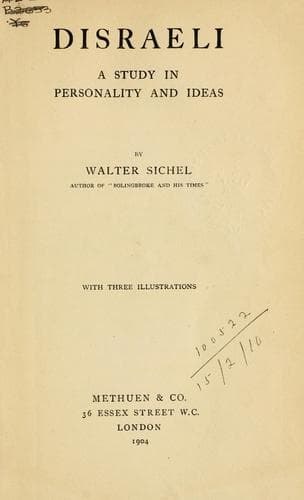
Disraeli: A Study in Personality and IdeasSichel, Walter
History
Disraeli: A Study in Personality and Ideas
Sichel, Walter
Disraeli, Benjamin, 1804-1881
energies of the present in a Gothic mausoleum, weird with wan emblems,
and chill and solemn as a cathedral vault.
Disraeli recognised that our country thrives by adaptation and
adjustment; that it is the region of natural growth, and not of sudden
blossom; of the oak, not the aloe. In inter-dependence, even more than
independence, in the mutual ties of classes, Disraeli discerned the
English root for democratic ideas which had all along lurked in the
soil. England is great because of that same insular inaccessibility to
ideas which repelled Heine. Her slowness of insight vanishes gradually,
and not by leaps and bounds--through growth and conduct rather than
through universal theories. An idea knocks at our gates for generations
before it wins admittance; but when it once enters, it becomes
naturalised and ceases to be alien; it becomes actualised; it dwells
and walks and votes, and has commerce at large. It becomes part of the
popular life and parcel of the national behaviour.
“Young England” prepared the ground for social regeneration. It sought
to raise the conditions of labour. It was no rose-water club, but,
short-lived as it proved, was a real forerunner of measures. A word,
therefore, upon it may be pardoned in this connection. Many in the
past century have played the part of “saviours of society.” Robert
Owen, Ferdinand Lassalle, Napoleon III., Karl Marx, and the eccentric
Mr. Urquhart, who furnished some of the _traits_ for Disraeli’s
“Sidonia.”[79] But none in this country have been at once so genuine
and effective as this association of “Young England;” for, enlisting
the enthusiasm of the high and the young, it struck into the roots of
national character, without which no development is feasible. Young
England aimed further, at rendering leadership sympathetic with labour.
It wanted to revive in the lowly a sense of privilege, and in the
noble to quicken higher standards of obligation; it wished to recall
the heroic; and this it tried to accomplish, not by social disturbance,
but by seeking to arouse ancient ideals still slumbering in national
traditions. For this purpose it appealed to youth--“the trustees of
posterity;”[80] to the power of personal influence and example; and
above all, it hoped, as I have already noticed, to counteract the
soullessness of utilitarianism.
“Ah, yes!” (Disraeli makes Gerard observe in _Sybil_); “I know that
style of speculation.... Your gentlemen who remind you that a working
man now has a pair of cotton stockings, and that Harry the Eighth was
not so well off. At any rate, the condition of classes must be judged
of by the age and by their relations with each other.”
It was also a vigorous protest against that retort of the Liberal on
the Radical--the sluggish doctrine of _laissez-faire_, the principle
of “stew-in-your-own-juice,” “devil take the hindmost,” “muddling
through,” and “let _ill_ alone.” Disraeli had combated it from the
first:--
Public-domain text, read in full here on John Shaqi.
Reviews
Reviews
No reviews yet
Be the first to share your thoughts on this work.
Elsewhere in the archive
Join the Discussion
Join the discussion
Sign in to leave a comment or review.
Sign InorCreate an account