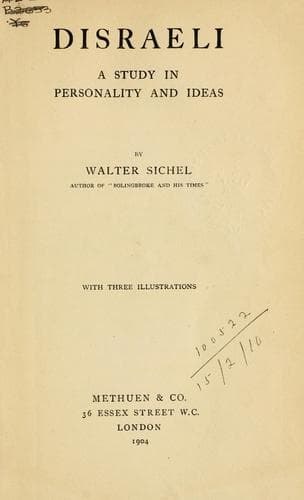
Disraeli: A Study in Personality and IdeasSichel, Walter
History
Disraeli: A Study in Personality and Ideas
Sichel, Walter
Disraeli, Benjamin, 1804-1881
“Ah, the People, this poor King in tatters,” wrote Heine from Paris
in 1848, “has fallen on flatterers far more shameless, as they swing
their censers around his head, than the courtiers of Byzantium or
Versailles. These court lackeys of the People incessantly vaunt its
virtues and excellences, crying aloud: ‘How beautiful is the People!
how good is the People! how intelligent is the People!’ No, you lie.
The People is not beautiful; on the contrary, it is very ugly. But its
ugliness is due to its dirt, and will vanish with public baths for the
free ablutions of his Majesty. A piece of soap, too, will do no harm;
and we shall then see a People in the beauty of cleanliness--a washen
People. The People whose goodness is thus magnified is not good at all.
It is often as bad as other potentates. But its baseness flows from
hunger. When once it has well eaten and drunk, it will smile, gracious
and well-favoured as the rest. Nor is his Majesty over-intelligent. He
is possibly stupider than the others--stupid with the bestiality of his
minions; he will only love or heed the speakers, or howlers, of the
jargon of his passions: he hates every brave soul that converses in the
speech of reason, and that would ennoble and enlighten him.”
Heine was leading “Young Germany.” A few years earlier, Disraeli was
leading “Young England.” The contrast between the atmosphere of the
two countries deserves a passing comment. “Young England” aimed at
betterment in that very feudal spirit which the poet--the “unfrocked
Romantic”--by turns breathed and spurned. In Germany the weird medley
of the “Romantic School” had for fifty years been striving to rewaken
the myths, the chivalry, the wistfulness of the past. But its direct
influences were merely æsthetic, and mainly sentimental; while they
eventually became actually anæmic--a vague reverie of mediæval
moonlight and pallid ghosts. The uprooting French Revolution had swept
away both castle and cobwebs, and in Germany the “folk-song” was the
sole antiquity to which this Romantic attachment could cling, and by
which it could touch the patriotism of a disunited people. But in
England, Scott’s “buff-jerkin” revival, at which Carlyle so unjustly
scoffed, was more than a literary sport; it had already braced the
nation with the fresh breeze of an invigorating tradition. It brought
back and home the inheritance of a real throne and a real nobility,
of chivalry, of daring, and of prowess; it reminded the people that
the humblest was once protected by the highest; and though it perhaps
burked or omitted much that disgraced the age of the tournament, the
foray, and the cloister, it quickened its best, its most hopeful and
most cheerful elements. It took the dry bones from their mouldering
tomb and put the breath of life, the wholesome laughter of humour,
and the brightness of beauty into and about their scattered fragments;
whereas in Germany the Romantics rather embalmed and buried the living
Public-domain text, read in full here on John Shaqi.
Reviews
Reviews
No reviews yet
Be the first to share your thoughts on this work.
Elsewhere in the archive
Join the Discussion
Join the discussion
Sign in to leave a comment or review.
Sign InorCreate an account