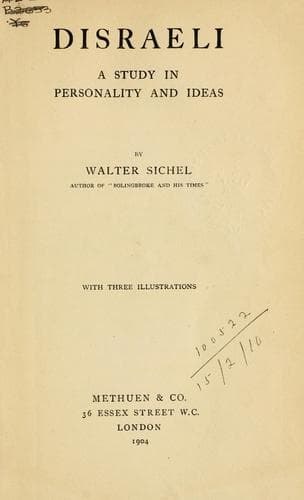
Disraeli: A Study in Personality and IdeasSichel, Walter
History
Disraeli: A Study in Personality and Ideas
Sichel, Walter
Disraeli, Benjamin, 1804-1881
The nucleus of “Young England” had begun in a close association of
university friends. The Cambridge “Apostles” comprised Tennyson and
Hallam, Monteith and Doyle, and “Cool-of-the-evening” Monckton-Milnes.
Disraeli, Lord Strangford, and Lord John Manners reinforced this
nucleus with Faber, Hope, Baillie Cochrane (afterwards Lord Lamington),
and others; they gave them an ampler scope and a longer view, but not
without murmuring jealousies. They taught that the spirit of reform
transcended its letter, and that the English “romantic school”--just
as later on the English pre-Raphaelites in Art--must reseek the
fountainhead of original principles. Milnes wrote in 1844: “You must
have been amused at the name of ‘Young England,’ which we started
so long ago, being usurped by opinions so different and so inferior
a tone of thought. It is, however, a good phenomenon in its way,
and one of its products--Lord John Manners--a very fine, promising
fellow. The worst of them is that they are going about the country
talking education and liberality, and getting immense honour for the
very things for which the Radicals have been called all possible
blackguards and atheists a few years ago.”
The newer Radical reforms, however, were based on “the greatest
happiness” principle of utility; whereas the league of “Young England”
was founded on the expansion of traditions, and more especially on
the immemorial rights of Labour. What “Young England” really effected
was to infuse enthusiasm into institutions. In 1838 this same “Mr.
Vavasour” of _Tancred_, and “Mr. Tremaine Bertie” of _Endymion_, had
also written: “We have set agoing a new dining club which promises
well. Twenty of the most charming men in the universe met last Tuesday.
They won’t call it ‘Young England,’ however.” It is no disrespect to
the memory of the late Lord Houghton to say that the vague eclecticism
of his youth scarcely fostered a robust energy or a keen insight. His
“remarks” on _Coningsby_ in _Hood’s Magazine_ under the name of “Real
England” were a sympathetic commentary; but, a born _dilettante_, he
“lionised” ideas as he “lionised” genius. He patted intuition on the
back. He was the Mrs. Leo Hunter of politics; and he played admirably
the part of “Bennet Langton” to Carlyle’s “Dr. Johnson.” He somewhat
prattled of “silences” and “eternities.” Well does Disraeli make
“Waldershare” in _Endymion_ exclaim of him: “... What I do like in him
... is this revival of the Pythagorean system, and heading a party of
silence. That is rich.”
Lord Lamington--the “Buckhurst” of _Coningsby_--who in his pleasant
glimpse of the movement has supplemented its muster-roll by the names
of Borthwick and Stafford, quotes Serjeant Murphy’s pasquinade of “Jack
Sheppard.” Its last verse runs as follows:--
Public-domain text, read in full here on John Shaqi.
Reviews
Reviews
No reviews yet
Be the first to share your thoughts on this work.
Elsewhere in the archive
Join the Discussion
Join the discussion
Sign in to leave a comment or review.
Sign InorCreate an account