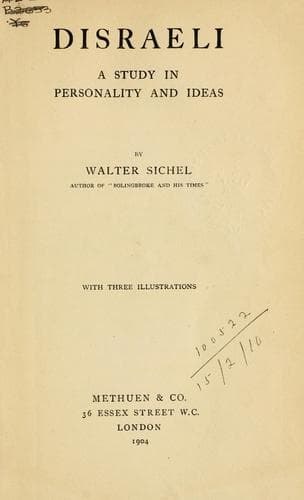
Disraeli: A Study in Personality and IdeasSichel, Walter
History
Disraeli: A Study in Personality and Ideas
Sichel, Walter
Disraeli, Benjamin, 1804-1881
“_We have Smythe and Hope with his opera-hat,
But they cannot get Dicky Milnes, that’s flat--
He is not yet tinctured with Puseyite leavening,
But he may drop in in the ‘cool of the evening.’_”
The “Puseyite leavening” recalls the strictures of Carlyle on the High
Church proclivities of a portion of the movement. Coleridge’s great
book on the Church had undoubtedly stirred both thought and enthusiasm.
Disraeli, as I shall show hereafter, wished to make the Church a
living social regenerator of the “national spirit,” to see it at once
disciplined and enthusiastic, to restore its original functions, to
render it really “Anglican;” and in his old age--strenuously opposed as
he ever was to the “mass in masquerade,” firmly resolved as he remained
to uphold orderly Protestantism--he has outlined at once a portrait and
a type of his permanent meaning in the person of “Nigel Penruddock;”
just as he has drawn a picture of “Young England” Anglicanism in the
“St. Lys” of _Sybil_, the prototype of whom was Faber.
In the spring of 1844, Carlyle thus characteristically addresses
Monckton-Milnes--
“... _On the whole, if ‘Young England’ would altogether fling its
shovel-hat into the lumber-room, much more cast its purple stockings to
the nettles, and honestly recognising what was dead, ... address itself
frankly to the magnificent but as yet chaotic Future, ... telling men
at every turn that it knew and saw for ever clearly the body of the
Past to be dead (and even to be damnable, if it pretended to be still
alive and to go about in a galvanic state), what achievement might
not ‘Young England’ manage for us!_” Carlyle was ever a free-thinking
Puritan, a creedless Calvinist. “What was dead,” “what pretended still
to be alive,” was the Church of England.... It is easy to deride that
youthful display of poor metre, but fine enthusiasm, “England’s Trust,”
by Lord John Manners.
“_With Roncesvalles upon his banners
Comes prancing along my Lord John Manners._”
Carlyle misliked in him what he disliked in Scott, the “properties” of
Romanticism. But the earnestness of Manners’s little volume is beyond
question. In the Church it recognises the national recuperative force
and salve for anarchy. “We laugh at all commandment save our own,”
sighs the boyish devotee--
“_Yes, through the Church must come the healing power
To bind our wounds in this tumultuous hour._”
Public-domain text, read in full here on John Shaqi.
Reviews
Reviews
No reviews yet
Be the first to share your thoughts on this work.
Elsewhere in the archive
Join the Discussion
Join the discussion
Sign in to leave a comment or review.
Sign InorCreate an account