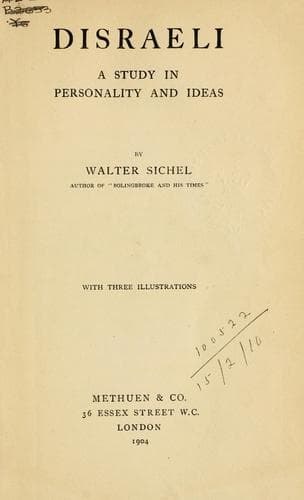
Disraeli: A Study in Personality and IdeasSichel, Walter
History
Disraeli: A Study in Personality and Ideas
Sichel, Walter
Disraeli, Benjamin, 1804-1881
It was not to be expected that such a cause, with such a leader,
followed by aristocratic youth and attended by the revival of
maypole dances and tournaments, should escape ridicule and even
suspicion. Grey-headed noblemen, who resented any efforts to render
institutions real, and for whom enthusiasm meant vulgarity, shook
their heads over the follies of their sons, seduced by the wiles
of a designing adventurer. But to such as still doubt Disraeli’s
sincerity in these matters, and refuse to be convinced by a long chain
of after-utterances, I would simply suggest the following fact.
Disraeli’s speech of April 11, 1845, on the Maynooth grant[81] broke
up the “Young England” association, and terminated his leadership of
it. What was the main principle of that speech? It was this: “... You
find your Erastian system crumbling from under your feet.... I have
unfaltering confidence in the stability of our Church, but I think that
the real source of the danger which threatens it is its connection with
the State, which places it under the control of the House of Commons
that is not necessarily of its communion.” He denied that the State
had ever “endowed” the Church. The Church owned property which was the
patrimony of the poor. He argued that since 1829 the State’s relation
to the Church had altered. He implied, as he often afterwards asserted,
that the union of Church and State was for the benefit of the State far
more than for that of the Church. Now, this attitude was eminently that
of his “Young England” professions. And yet its fearless expression
dissolved a gathering which his detractors maintained was used merely
as a step to personal advancement.
Carlyle, in the passage above cited, evinced the same irritable
impatience that he exhibited in 1849, when he cursed parliamentary
institutions because a particular Parliament had over-talked itself.
He was an iconoclast who, however, often confused the symbol with the
faith that underlies it, and in dethroning the image would have dashed
the glamour of its shrine. In 1848--the year of anarchy--Disraeli made
a famous speech (the speech which procured him his future leadership of
the House). He upheld these institutions while he denounced that very
Parliament which moved Carlyle’s indignation. The future has proved him
right, and the sage wrong. The practical fruits of the future, too,
have vindicated the peculiar tinge that Disraeli himself lent to the
“Young England” brotherhood.
One closing word on the social aims of “Young England.” I may summarise
them by the phrase “Health and Home.” They compassed the relief of
industry, and they implied the effort to shame the knights of industry
into some chivalry towards it.
Public-domain text, read in full here on John Shaqi.
Reviews
Reviews
No reviews yet
Be the first to share your thoughts on this work.
Elsewhere in the archive
Join the Discussion
Join the discussion
Sign in to leave a comment or review.
Sign InorCreate an account