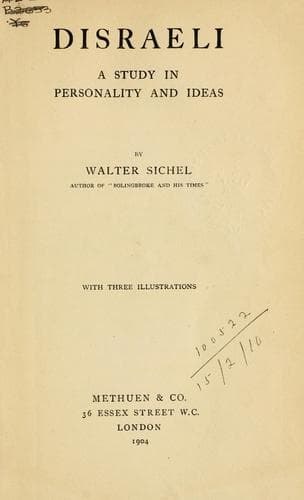
Disraeli: A Study in Personality and IdeasSichel, Walter
History
Disraeli: A Study in Personality and Ideas
Sichel, Walter
Disraeli, Benjamin, 1804-1881
The two river bills carried at Disraeli’s instigation in 1852; the
twenty-nine bills for ameliorating the position of factory operatives,
passed despite those Radicals who predicted ruin for the manufacturer;
the Employers and Workmen Acts, the Conspiracy and Protection of
Property Act, the Poor Law Amendment Act, the Commons Act, the
Artisans’ Dwellings Acts, the Public Health Act, the Rating Act,
the Employers’ Liability Acts, the Agricultural Holdings Act, among
many others, attest the victory of “popular Toryism” over “class
Liberalism,” and the protection of suffering against selfishness.
“Young England,” like all Utopian propaganda, was a romantic vision,
and exceeded actuality. But in essence it has been eminently practical.
Classes (of which England is made) are infinitely more in communion
than they were in 1840. The effort to set them by the ears and to
oppose the “masses” to the “classes” has ignominiously failed. The
Church of England has roused itself to the national needs beyond all
comparison with those days. The appeals of _Sybil_, _Coningsby_, and
_Tancred_, ridiculed as rodomontade and branded as a charlatan’s
dodge, have been rendered into action, and stand confessed as the
deeply felt and pondered schemes of a poet and a statesman. “When,”
says Bolingbroke, “great coolness of judgment is united to great
warmth of imagination, we see that happy combination which we call a
genius.” Such has proved Disraeli, and his inmost soul is embodied in
that “Young England” which he organised and encouraged in a freezing
atmosphere. Over fifty years ago he exhorted youth, at the Manchester
Athenæum, as “the trustees of posterity.” “The man,” he then said, “who
did not look up would look down, and he who did not aspire was destined
perhaps to grovel.” The youth of to-day is far more conscious of its
burden than was the youth of any class in the ’forties.
Public-domain text, read in full here on John Shaqi.
Reviews
Reviews
No reviews yet
Be the first to share your thoughts on this work.
Elsewhere in the archive
Join the Discussion
Join the discussion
Sign in to leave a comment or review.
Sign InorCreate an account