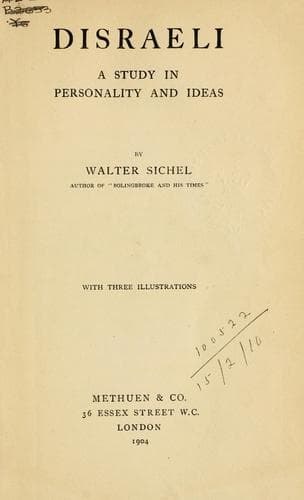
Disraeli: A Study in Personality and IdeasSichel, Walter
History
Disraeli: A Study in Personality and Ideas
Sichel, Walter
Disraeli, Benjamin, 1804-1881
It was mainly on these social grounds that Disraeli resisted that
system of free imports which has gone down to history as “Free Trade.”
He never denied that it was calculated to enrich manufacturers
and manufacturing centres; he grew to admit its benefits to the
consumer, although these were by no means wholly due to its action;
but he deprecated its “economic frenzy.” He held that it injured the
producer[82] and played havoc both with land and distribution of
labour. He thought it would eventually impair morale and physique,
and sacrifice the general welfare to the material interests of a
class; and, before it was nationally adopted, he considered that all
ends would have been better served by the adoption of that system
of reciprocal treaties[83]--on a principle called by him “at once
national and cosmopolitan”--which was termed “Free Trade” in the days
of Pitt, and had been inaugurated in 1713 by the abortive tariff of
the great Utrecht Treaty; nor will it now be doubted that if in 1846 a
comprehensive scheme of technical education had been set on foot, many
of the evils engendered by over-competition would have been avoided,
whatever fiscal system this country had chosen.
Writing so early as 1832 to the Wycombe electors, he even then
declared: “... With regard to the Corn Laws, I will support any change,
the basis of which is _to relieve the consumer without injuring the
farmer_.” This was not the “Radical” doctrine of those days.
Disraeli has shown conclusively that in English history such a
principle as absolute “protection” never existed. The original
principle up to the time of Anne was to feed and supply a population
then small enough so to be supported at home, and to encourage the
wealth and power of trade. He has shown that Walpole, in this respect
imitating the rival whom he destroyed, wisely followed this principle
in its colonial applications; though he unwisely divorced productive
trade from the land, and set the moneyed against the landed classes,
the high finance against the country gentlemen, into whose shoes,
however, it soon stepped. He has shown that when the colonial system
broke down by the secession of our greatest and worst governed colony,
Pitt the Second reverted to the old, the natural principle of exchange
with the continent by tariff. The exigencies of the Revolutionary and
Napoleonic wars forced an interlude; and for a time England was fed
by foreign corn in free competition with her own--the very time when
the loaf was dearest. But Lord Liverpool recurred to the principle;
and Peel up to 1845--when his hand was confessedly forced by the
appalling famine in Ireland--was in favour of the varying duties termed
the sliding scale, as opposed to the fixed duties of the Whigs and
the no-duties of the Radicals. That scale he eventually surrendered
under the impulse of Lord John Russell’s “Edinburgh Letter,” and was
suddenly converted by the Manchester School. In logic, and apart from
Public-domain text, read in full here on John Shaqi.
Reviews
Reviews
No reviews yet
Be the first to share your thoughts on this work.
Elsewhere in the archive
Join the Discussion
Join the discussion
Sign in to leave a comment or review.
Sign InorCreate an account