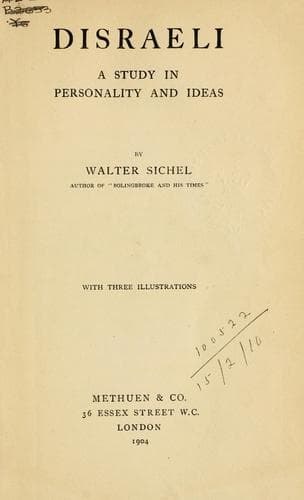
Disraeli: A Study in Personality and IdeasSichel, Walter
History
Disraeli: A Study in Personality and Ideas
Sichel, Walter
Disraeli, Benjamin, 1804-1881
Disraeli over and over again affirmed that since the nation had
endorsed this vital change, its reversal was impracticable unless the
considered national demand for it became overwhelming. It was one
of his cardinal ideas that without such deliberate demand no great
change of national policy should be risked in any department. In
1852, he and Lord Derby appealed to the country on a modified issue
of this question--that of a fixed duty. The country’s answer Disraeli
considered as final, even in that regard; nor, so far as he was able,
would he ever permit these momentous issues to be reopened by any
party or section. He remained devoted to the reciprocity principle.
He believed that “give and take” is the foundation of trade which
is barter. But, though he descried rocks ahead in the future, he
recognised that the consumer had benefited by the free opening of our
ports, that so far as material wealth was concerned, England had become
the emporium and the banker of the world. On the other hand, this very
prosperity had aggravated the misery of a class and had raised those
problems which are still engaging anxious attention. Utilitarianism,
the “cheapest market” theory, had triumphed in the establishment of
unrestricted competition, but the upshot of that competition was an
increasing strain and disorganisation of native labour. With these
evils he left the quickened spirit of “Young England” to cope; while he
himself strove to meet them by the remission of the now unjust burdens
laid on the land, his industrial franchise bill, and his cherished
policy of _sanitas sanitatum_. He had, at any rate, largely influenced
the opinion of his generation in bringing home to men’s minds and
consciences the equality of the rights of Labour with those of
property, and the adequacy of constitutional forms to enforce them; nor
did he ever cease to press them in his writings and speeches. But as a
statesman he had always to choose between evils; and of these a forced
disturbance of a nationally adopted system, which by hasty expedients
might tend to disorder and to dispersal, he ever considered the graver.
To experiment he always opposed experience.
Speaking only two years before his death, he said--
Public-domain text, read in full here on John Shaqi.
Reviews
Reviews
No reviews yet
Be the first to share your thoughts on this work.
Elsewhere in the archive
Join the Discussion
Join the discussion
Sign in to leave a comment or review.
Sign InorCreate an account