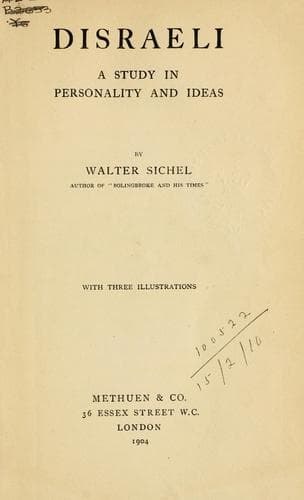
Disraeli: A Study in Personality and IdeasSichel, Walter
History
Disraeli: A Study in Personality and Ideas
Sichel, Walter
Disraeli, Benjamin, 1804-1881
But any prohibitive tax on foreign manufactures--that is another
matter, one which would protect certain trades at the expense of the
community, and aggravate the very evils which Free Trade introduced.
Such a system must press all the harder on that class of consumers
whose pay would remain unaffected by its results, and who would, in
fact, be subsidising our colonies out of their emptied pockets. The
sentiment of the colonies he would have prized beyond measure, but
other means for riveting it might be found; and in the undeveloped
condition of many among them, would not a Canadian favouritism sow a
harvest of jealousies? Moreover, the colonial population as a whole
is still far too scanty for the replacement of our markets abroad;
and further, the two main channels of cheap capital and British
prosperity--our carrying trade and London’s commercial position as
the clearing-house of the world--might be revolutionised by changes,
to which no limit could be fixed. And again, the remission of Income
Tax ought in justice to accompany such a system, for that tax was
revived by Peel expressly because the revenue had to be reimbursed for
its losses on adopting the measures for free imports. With respect to
“dumping,”[85] its conditions contain its cure. England, no longer
the main workshop of the world, cannot perhaps be so generous as
heretofore, but she can still afford to be generous. As for the promise
of higher wages through protective duties, wages are more likely
to rise through the resumption of gold imports from South Africa;
while the joint result of retaliatory tariffs and such imports would
be doubly to enhance the price of commodities for the mass. On the
other hand, the vision of a self-supporting empire he would honour,
and equally the sincere and commanding zeal of its prophet. But he
would surely argue that the times were far from ripe, and that small
and gradual beginnings might lay firmer foundations than a colossal
combination of incompatibles. Again, he would, as the writer fancies,
deplore a loud and unsolicited appeal to the passions of a multitude
and the greed of a class easily thus led into a lordship of mob
despotism. At the same time, he would certainly recognise, as Mr.
Chamberlain alone has fully recognised, the crying need for a better
distribution of employment.
Public-domain text, read in full here on John Shaqi.
Reviews
Reviews
No reviews yet
Be the first to share your thoughts on this work.
Elsewhere in the archive
Join the Discussion
Join the discussion
Sign in to leave a comment or review.
Sign InorCreate an account