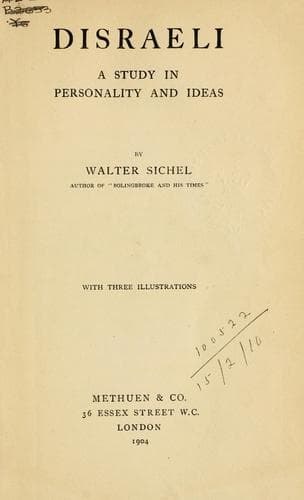
Disraeli: A Study in Personality and IdeasSichel, Walter
History
Disraeli: A Study in Personality and Ideas
Sichel, Walter
Disraeli, Benjamin, 1804-1881
What was present to Disraeli’s mind was not only that, in such a case,
the ancient landmarks of parish life, the ancient trusts of education,
the ancient equality of social intercourse between clergy and laity,
the ancient duties and intimacies, the ancient openness to the poorest
of career in the Church and of residence on the land, would be swept
away; but that, as he expressed it when discussing the “Cowper-Temple
Amendment” in 1870, “you will not entrust the priest or the presbyter
with the privilege of expounding the Holy Scriptures ... _but for that
purpose you are inventing and establishing a new sacerdotal class_.”
“My idea of sacerdotal despotism,” he said in 1863, “is this, that
a minister of the Church of England, who is appointed to expound
doctrine, should deem that he has a right to invent doctrine. That ...
is the sacerdotal despotism I fear....” The State would suffer; and it
would suffer doubly. Not only would religion cease to be an official
element of order, but the ministers of religion might be unduly
strengthened in civil affairs--might be over-politicised. “Whether
that is a result to be desired,” he remarked ten years afterwards,
“is a grave question for all men. For my own part, I am bound to say
that I doubt whether it would be favourable to the cause of civil and
religious liberty.”
In his novels he emphasises his belief that society is inconceivable
without religion, and that “without a Church there can be no true
religion, because otherwise you have no security for the truth,”
although he also distinguishes between differing “orthodoxies” and
real religion. At the same time, the Church as a polity must have
dogmas--“No Church, no creed”--“no dogmas, no deans, Mr. Dean.”
The human craving, the passionate instinct for religion, he ever
based--from the date of _Contarini Fleming_ and _Alroy_ to that
of _Coningsby_ and _Tancred_, and from that of _Tancred_ to that
of _Lothair_--on the fact that “_man requires that there shall be
direct relations between the created and the Creator, and that in
those relations he should find a solution of the perplexities of
existence_.”--“The brain that teems with illimitable thought will never
recognise as his Creator any power of nature, however irresistible,
that is not gifted with consciousness.... The Church comes forward,
and without equivocation offers to establish direct relations between
God and man. Philosophy denies its title and disputes its power. Why?
Because they are founded on the supernatural. What is the supernatural?
Can there be anything more miraculous than the existence of man and the
world? Anything more literally supernatural than the origin of things?
The Church explains what no one else pretends to explain, and which
every one agrees it is of first moment should be made clear.”
Public-domain text, read in full here on John Shaqi.
Reviews
Reviews
No reviews yet
Be the first to share your thoughts on this work.
Elsewhere in the archive
Join the Discussion
Join the discussion
Sign in to leave a comment or review.
Sign InorCreate an account