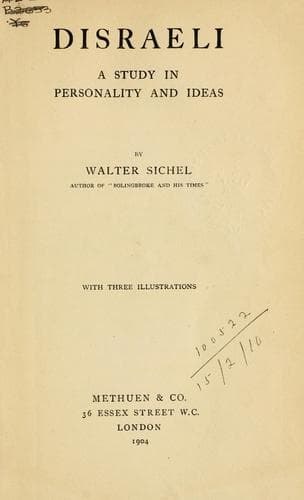
Disraeli: A Study in Personality and IdeasSichel, Walter
History
Disraeli: A Study in Personality and Ideas
Sichel, Walter
Disraeli, Benjamin, 1804-1881
The Church’s “nationality” is proved even by the peculiar character of
her property. It is territorial. It is (as he emphasised in a speech of
1862) “... so distributed throughout the country, that it makes that
Church, from the very nature of its tenure, a national Church; and the
power of the Church of England does not depend merely on the amount
of property it possesses, but in a very great degree on the character
and kind of that property. Then I say that the Church, deprived of its
status, would become merely an _episcopal sect_ in this country. And in
time, it is not impossible it might become an insignificant one. But
that is not the whole, nor, perhaps, even the greatest evil, that might
arise from the dissolution of the connection between Church and State,
because in the present age the art of government becomes every day more
difficult, and no Government will allow a principle so powerful as the
religious principle to be divorced from the influences by which it
regulates the affairs of a country. What would happen?... The State of
England would take care, after the Church was spoiled, to enlist in its
service what are called the ministers of all religions. They would be
salaried by the State, and the consequences of the dissolution of the
alliance between Church and State would be one equally disastrous to
the Churchman and to the Nonconformist. It would place the ministers of
all spiritual influences under the control of the civil power, and it
would in reality effect a revolution in the national character....”
De Tocqueville has proved that the French clergy were the staunchest
upholders of civil liberty before the Revolution; but he has also
acutely shown that the Roman priesthood, devoid of domestic ties, looks
to the Church as its sole fatherland, unless it can itself become a
proprietor of the soil. The French Revolution disempowered it for that
purpose, and evicted it from its heritage. The English clergy, on the
other hand, are linked to civil life both by the land and the home.
Contrast for one moment the landscape of a French village with that of
an English, and the difference becomes typified. In the one the church
stands aloof and dominates the hamlet. In the other it nestles among
the cottages, and helps the daily life around it.
Public-domain text, read in full here on John Shaqi.
Reviews
Reviews
No reviews yet
Be the first to share your thoughts on this work.
Elsewhere in the archive
Join the Discussion
Join the discussion
Sign in to leave a comment or review.
Sign InorCreate an account