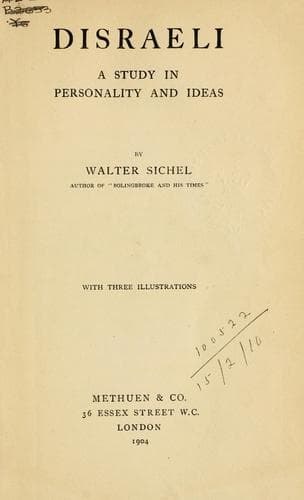
Disraeli: A Study in Personality and IdeasSichel, Walter
History
Disraeli: A Study in Personality and Ideas
Sichel, Walter
Disraeli, Benjamin, 1804-1881
of all her Majesty’s subjects--that it will allow no consideration to
divert its mind and energy from the accomplishment of its object. It,
therefore, necessarily takes what is commonly called a contracted view.
But who can doubt what will be the result, _when on a question which
enlists and excites all the religious passions of the nation, the zeal
of enthusiasm advocates one policy, and the calmness of philosophers
and the experience of statesmen recommend another. The Government
might be right, but the Government would not be able to enforce its
policy, and the question might be decided in a way that might disturb
a country or even destroy an empire._ I know, sir, it may be said that
though there may be some truth in this view abstractedly considered,
yet it does not apply to the country in which we live, because ... we
enjoy religious freedom ... and because only a portion of her Majesty’s
subjects are in communion with the National Church. I draw a very
different conclusion to that which I have supposed as the objection....
_It is because there is an Established Church that we have achieved
religious liberty and enjoy religious toleration; and without the union
of the Church with the State, I do not see what security there would be
either for religious liberty or toleration._ No error could be greater
than to suppose that the advantage of the Established Church is limited
to those who are in communion with it. Take the case of the Roman
Catholic priest. He will refuse--and in doing so he is quite justified,
and is indeed bound to do so--he will, I say, refuse to perform the
offices of the Church to any one not in communion with it. The same
with the Dissenters. It is quite possible--it has happened, and might
happen very frequently--that a Roman Catholic may be excommunicated
by his Church, or a sectarian may be denounced and expelled by his
congregation; but if that happens in this country, the individual in
question who has been thus excommunicated, denounced, or expelled, is
not a forlorn being. There is the Church, of which the Sovereign is
the head, which does not acknowledge the principle of Dissent, and
which does not refuse to that individual those religious rites which
are his privilege and consolation.... Now, I cannot believe that the
disendowment of the Church of England could occur without very great
disturbances.... _England cannot afford revolution. England has had
her revolutions. It is indeed because she had revolutions about two
hundred years ago, before other nations had their revolutions, that
she gained her great start in wealth and empire._ Now, sir, what have
we gained by these revolutions? A period of nearly two hundred years
of great serenity and the secured stability of the State. I attribute
these happy characteristics of our history to the circumstance, that in
this interval we did solve two of the finest and profoundest political
problems. We accomplished complete personal, and, in time, complete
Public-domain text, read in full here on John Shaqi.
Reviews
Reviews
No reviews yet
Be the first to share your thoughts on this work.
Elsewhere in the archive
Join the Discussion
Join the discussion
Sign in to leave a comment or review.
Sign InorCreate an account