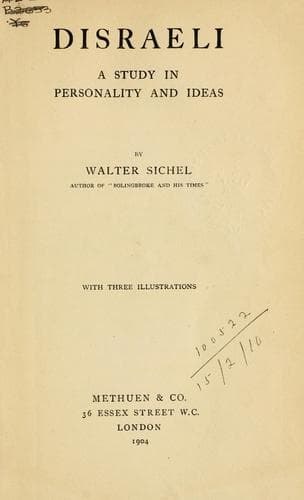
Disraeli: A Study in Personality and IdeasSichel, Walter
History
Disraeli: A Study in Personality and Ideas
Sichel, Walter
Disraeli, Benjamin, 1804-1881
“When we have to decide whether we can dissociate the principle of
religion from the State, it is well to remember that we are asked
to relinquish an influence that is universal. We hear in these days
a great deal of philosophy. Now, it is my happiness in life to be
acquainted with eminent philosophers. They all agree in one thing. They
will all tell you that, however brilliant may be the discoveries of
physical science, however marvellous those demonstrations which attempt
to penetrate the mysteries of the human mind, wonderful as may be
these discoveries, greatly as they have contributed to the comfort and
convenience of man, or confirmed his consciousness of the nobility of
his nature--yet all those great philosophers agree in one thing--that
in their investigations there is an inevitable term where they meet
the insoluble, where all the most transcendent powers of intellect
dissipate and disappear.[99] There commences the religious principle.
It is universal, and it will assert its universal influence in the
government of men. Now, I put this case before the House. We are asked
to commence a great change.... When, therefore, we are called to the
consideration of these circumstances, it is absolutely necessary that
we should contemplate the possibility of our establishing a society
in which there may be two powers, the political and the religious,
and the religious may be the stronger.[100] Now I will take this
case. Under ordinary circumstances, a Government performing those
duties of police, to which it will be limited when the system has
perfectly developed, the first step to which we are called upon to
take to-night--such a Government, under ordinary circumstances, will
be treated with decent respect. But a great public question, such as
has before occurred in this country, and as must periodically occur
in free and active communities--a great public question arises, which
touches the very fundamental principles of our domestic tranquillity,
or even the existence of the Empire; but the Government of the country,
and the religious organisations of the country, take different views,
and entertain different opinions on that subject. In all probability
the Government of the country will be right. The Government in its
secret councils is calm and impartial, is in possession of ample and
accurate information, views every issue before it in reference to the
interests of all classes, and takes, therefore, what is popularly
called a comprehensive view. The religious organisation of the country
acts in quite a different manner. It is not calm; it is not impartial;
it is sincere, it is fervid, it is enthusiastic. Its information is
limited and prejudiced. It does not view the question of the day in
reference to the interests of all classes. It looks upon the question
as something of so much importance--as something of such transcendent
interest, not only for the earthly, but even for the future welfare
Public-domain text, read in full here on John Shaqi.
Reviews
Reviews
No reviews yet
Be the first to share your thoughts on this work.
Elsewhere in the archive
Join the Discussion
Join the discussion
Sign in to leave a comment or review.
Sign InorCreate an account