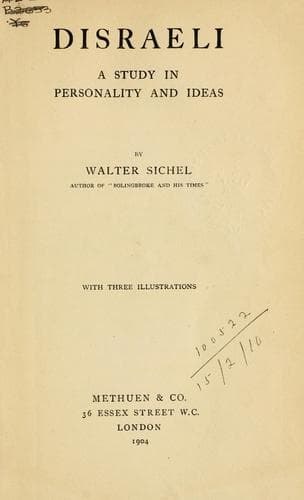
Disraeli: A Study in Personality and IdeasSichel, Walter
History
Disraeli: A Study in Personality and Ideas
Sichel, Walter
Disraeli, Benjamin, 1804-1881
“... _The notes on the gamut of their feeling are few, but they are
deep. Industry, Liberty, Religion, form the solemn scale. Industry,
Liberty, Religion--that is the history of England._” He predicts a
feeling of exaltation for religion similar to those enthusiasms for
freedom and toil which have inspired the nation in recent periods,
and he harps on the opportunity for a Church with a tradition of
“the beauty of holiness.” “What a field for a corporation which is
not merely a Church, but ... the Church of England; blending with a
divine instruction the sentiment of patriotism, and announcing herself
as the Church of the country;” which may realise its nationality by
increasing her hold on the education[102] of the people, “though it is
possible there may be fresh assaults and attacks upon the machinery
by which the State has assisted the Church in that great effort;” by
extending the Episcopate (which has happened); by developing the lay
element in the administration of her temporal affairs; by fulfilling
the right of visitation both by priest and parishioner, and maintaining
those parochial privileges which are still inviolate both in town and
country; by remedying the gross inequality of stipend (which remains to
be done); by, so far as possible, relying on the Church itself, and not
resorting to the Legislature.
With respect to indifferentism among the more enlightened classes, it
is “agnosticism,” partly due to the scientific spirit on which I have
touched; partly to that “higher criticism” which Germany originated,
and which, it is clear, can only modify the views of an educated few.
With the mild rationalism of “Essays and Reviews,” Disraeli dealt
characteristically. He found them “at the best a second-hand medley of
contradictory and discordant theories.” Thirty years earlier he had
satirised those devout Christians who do not believe in Christianity.
As in the march of Science he perceived nothing new, and held that it
interpreted the imagery without sapping the foundations of belief, so
with regard to the “Teutonic rebellion” against inspiration, he saw
only repeated in another form, and with no more ability, the Celtic
“insurrection” which distinguished the eighteenth century: both had
their uses. “Man brings to the study of oracles more learning and more
criticism than of yore; and it is well that it should be so.” Nay, the
very development of the German theological school proves its ephemeral
character.
Public-domain text, read in full here on John Shaqi.
Reviews
Reviews
No reviews yet
Be the first to share your thoughts on this work.
Elsewhere in the archive
Join the Discussion
Join the discussion
Sign in to leave a comment or review.
Sign InorCreate an account