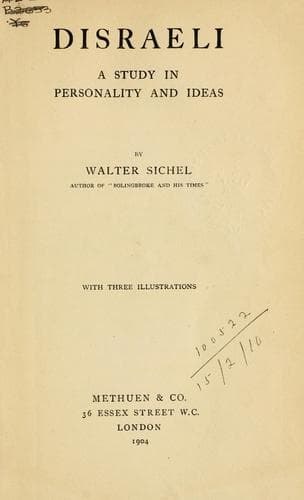
Disraeli: A Study in Personality and IdeasSichel, Walter
History
Disraeli: A Study in Personality and Ideas
Sichel, Walter
Disraeli, Benjamin, 1804-1881
This imperial form of Theocracy exercised for him, both imaginatively
and historically, an enormous attraction. Its special appeal to
the Latin and Celtic races; its unbroken phalanx of organisation;
its immemorial persistence of policy; its creative combination of
spirituality with art, of purity with beauty; its union of ideals
beyond and above the world with the mechanism of empires; its blend
of contrasts, of solemn softness with sombre control, of charm with
coldness, of callousness with charity, of loneliness with society,
of curse and comfort; its theoretic espousal of theological free
will with the practical denial of it in action, and of outward pomp
with inward simplicity; its watchful intimacies with every moment of
life--the way in which, as he puts it in _Contarini_, it “... produces
in” its “dazzling processions and sacred festivals an effect upon the
business of the day;” its guardianship of the weak, the erring, and
the poor; its nursing motherhood of doubt and despair; its insidious
captivation of the will and intellect; its power to recall and continue
the spirits of the centuries, to absorb schism and rebaptise it union;
its claims to obliterate the past for the penitent; to keep all things
old and make all things new; its great deeds and its great heroes;
these elements and many more, that have cooped Jews in Ghettos while
blazoning the proud inscription in front of St. Peter’s, _Vicit Leo
de tribu Juda_,--all these opposites enchant even when they fail to
enchain the mind and the feelings. They have linked the Vatican and
the Palatine, the see to the throne, the tiara to the diadem. They
have transfigured, while maintaining, pagan rites and customs, till
“Madre Natura” reappears with a halo, the very shrines of the Madonna
repeat the antique pattern of those dedicated to the Lares and Penates,
and the procession of waxen images in Southern Italy but perpetuates
another and an older ceremony. The Roman Church has been the most
consistent educator, the greatest organiser, the most universal
legislator of the last thousand years. It has attained uncompromising
ends unswervingly pursued by compromises the most subtle and the most
skilful. Nor is the esoteric doctrine which recalls the Eleusinian
Mysteries, and enables the initiated to regard forms comprehensible
by the multitude as merely popular symbols of higher truths, without
a certain glamour of its own. Disraeli’s father had penned a treatise
on the Jesuits, and their history had been deeply studied by the son.
I can still recall the unconscious tone of ironical appreciation
with which one of those “professors,” “capable of effecting a great
influence on the youth of England,” informed me that when he met
Disraeli, “he spoke to me of the Jesuits.” Both the two factors in
himself which I have mentioned, the sense of mystery and the impulse to
control, are precisely the atmosphere of the Papal Church. There was,
therefore, to some extent the attraction of affinity.
Public-domain text, read in full here on John Shaqi.
Reviews
Reviews
No reviews yet
Be the first to share your thoughts on this work.
Elsewhere in the archive
Join the Discussion
Join the discussion
Sign in to leave a comment or review.
Sign InorCreate an account