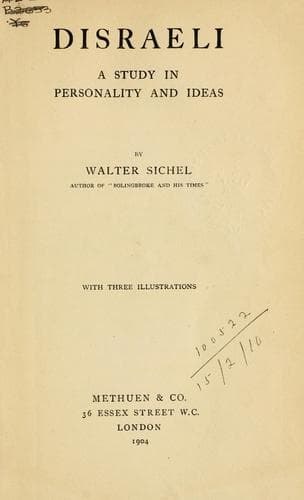
Disraeli: A Study in Personality and IdeasSichel, Walter
History
Disraeli: A Study in Personality and Ideas
Sichel, Walter
Disraeli, Benjamin, 1804-1881
But the Papacy
appealed to him imaginatively, not theologically, as it did to his
great rival. I recollect being told by a member of the symposium that
Gladstone once discussed deep into the night at Hawarden what form of
Christianity would eventually survive and prevail. Three chosen friends
agreed with him that it would be Romanism, the establisher and not the
establishment, the supernational and not the national, theocratic and
not (as Disraeli makes one of his characters describe the Church of
England) “parliamentary Christianity.”
Not so Disraeli. Its political influences, its “clamour for
toleration,” its “labour for supremacy,”[106] its warping limitations,
its prying priestcraft, its humble haughtiness, its casuistic candour,
its centralising forces fatal to Northern liberty, the ban placed
on free discussion and free intercourse, its proclamation of the
uniformity rather than of the unity of human nature, and above all
its admixture of paganism, were the drawbacks that repelled him. “The
tradition of the Anglican Church was powerful,” he observes, adverting
to that “mistake and misfortune” of Newman’s desertion. “Resting on the
Church of Jerusalem, modified by the divine school of Galilee, it would
have found that rock of truth which Providence, by the instrumentality
of the Semitic race, had promised to St. Peter. Instead of that, the
seceders sought refuge in mediæval superstitions which are generally
the embodiments of pagan ceremonies and creeds.”[107]
The spell of Romanism is an incident in _Contarini Fleming_. The spell,
but also the perils of Romanism, its bewitchment of judgment and of
conscience, its repugnance to free politics and independent wills,
its arrogance of inspiration, its monopolies, its burdens of enjoined
etiquette, form the theme of _Lothair_. He cannot bind himself to the
danger, yet how adorable is its source! How firm the rock on which it
is founded, when it is not of offence! How certain the conclusions, if
only the premises can be conceded!
Public-domain text, read in full here on John Shaqi.
Reviews
Reviews
No reviews yet
Be the first to share your thoughts on this work.
Elsewhere in the archive
Join the Discussion
Join the discussion
Sign in to leave a comment or review.
Sign InorCreate an account