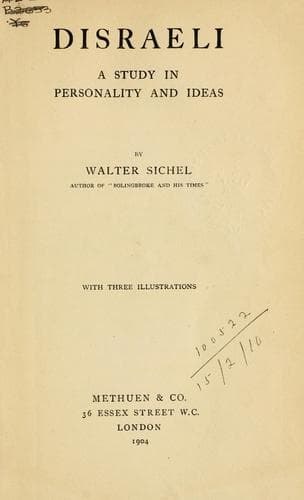
Disraeli: A Study in Personality and IdeasSichel, Walter
History
Disraeli: A Study in Personality and Ideas
Sichel, Walter
Disraeli, Benjamin, 1804-1881
“The basis on which God has willed that His revelation should rest in
the world is the testimony of the Catholic Church, which, if considered
only as a human historical witness of its own origin, constitution, and
authority, affords the highest and most enduring evidence for the facts
and contents of the Christian religion. If this be denied, there is no
such thing as history. But the Catholic Church is not only a human and
historical witness of its own origin, constitution, and authority, _it
is also a supernatural and Divine witness, which can neither fail nor
err_. When it œcumenically speaks, it is not merely the voice of the
Father of the World; it declares ‘_what it hath seemed good to the Holy
Ghost and to us_.’”
No wonder that “Lothair,” sitting down in the crisis of his life
by the moonlit Coliseum, muses in a rhapsody of the magnetism for
opposed causes of the genius of the spot, strangely anticipating
Zola’s contrast between the new Italian “Orlando” and the old Italian
“Boccanera.”
“Theodora lived for Rome and died for Rome. And the Cardinal, born and
bred an English gentleman, with many hopes and honours, had renounced
his religion and, it might be said, his country, for Rome; and his
race for three hundred years had given, for the same cause, honour,
and broad estates, and unhesitating lives. And these very people
were influenced by different motives, and thought they were devoting
themselves to opposite ends. But still it was Rome; Republican or
Cæsarian, papal or pagan, it still was Rome.”
I have shown the sources, as I believe, of Disraeli’s convictions.
He was the first to dwell on those problems of race which are now
recognised. His derided “Asian mystery” has been amply justified. His
view of the “Caucasian” is that of subsequent science. Writing nearly
forty years after he had mooted his ideas, he observed: “familiar as we
all are now with such themes ... the difficulty and hazard of touching
for the first time on such topics cannot now be easily appreciated.”
His beliefs were _racial_, and depended on the clue of race to history.
Their applications, however, were _national_. For he knew that race
is only an element among the shared associations and common language,
customs and history, that make up that ideal assembly which is called
a nation; and he also knew that mere communication is not communion;
that the rapidity of increased methods of material intercourse will
never extinguish the slow, but certain, fires of race discord, which
can only “consume its own smoke” through the free fusion of nationality.
Public-domain text, read in full here on John Shaqi.
Reviews
Reviews
No reviews yet
Be the first to share your thoughts on this work.
Elsewhere in the archive
Join the Discussion
Join the discussion
Sign in to leave a comment or review.
Sign InorCreate an account