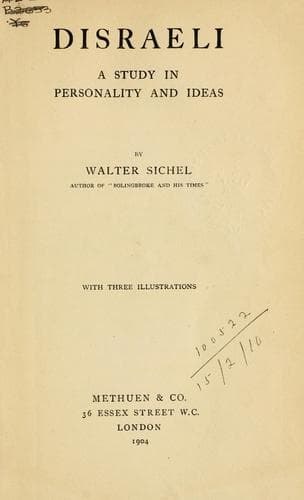
Disraeli: A Study in Personality and IdeasSichel, Walter
History
Disraeli: A Study in Personality and Ideas
Sichel, Walter
Disraeli, Benjamin, 1804-1881
His own race he cleared from prejudice, and proudly displayed as a
potent, if sometimes hidden, force throughout the world. His praise
and illustration of its endowments, its strength by virtue of its
purity of strain, its tenacity and power of organisation, its veiled
ramifications among the mainsprings that move Governments and alter
systems, no longer raise a smile; and if they did, they would certainly
cease to do so when placed on the lips of Macaulay, who thus treated
them--
“He knows,” said Macaulay, speaking in 1833 of the member for the
University of Oxford--“he knows that in the infancy of civilisation,
when our island was as savage as New Guinea, when letters and arts
were still unknown to Athens, when scarcely a thatched hut stood on
what was afterwards the site of Rome, this contemned people had their
fenced cities and cedar palaces, their splendid Temple, their fleets of
merchant ships, their schools of sacred learning, their great statesmen
and soldiers, their natural philosophers, their historians and their
poets.... Let us open to them every career in which ability and energy
can be displayed. Till we have done this, let us not presume to say
that there is no genius among the countrymen of Isaiah, or heroism
among the descendants of the Maccabees.”
CHAPTER V
MONARCHY
“To change back the oligarchy into a generous aristocracy round a _real
throne_,” Disraeli ranks, with his ideal mission towards the Church, as
“the trainer of the nation;” towards Labour, to “the moral and physical
condition of the people;” towards Ireland, by governing it “according
to the policy of Charles I., and not of Oliver Cromwell;” to Reform,
by emancipating “the political constituency of 1832 from its sectarian
bondage and contracted sympathies.”
“Sovereignty,” he says, in the peroration to _Sybil_, “has been the
title of something that has had no dominion, while absolute power
has been wielded by those who profess themselves the servants of the
people. In the selfish strife of factions, two great existences have
been blotted out of the history of England--_the Monarch and the
Multitude_; as the power of the Crown has diminished, the privileges of
the people have disappeared....” Such was Disraeli’s summary in 1870 of
what inspired “Young England” in 1840. The more real is representation,
the greater the chances of royalty. De Tocqueville, too, has shown that
it was just the decay of mediæval, municipal institutions that loosened
the hold of the French Crown on the French nation.
Public-domain text, read in full here on John Shaqi.
Reviews
Reviews
No reviews yet
Be the first to share your thoughts on this work.
Elsewhere in the archive
Join the Discussion
Join the discussion
Sign in to leave a comment or review.
Sign InorCreate an account