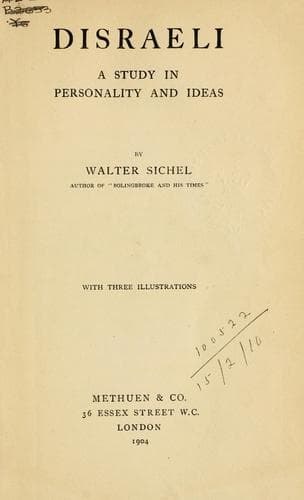
Disraeli: A Study in Personality and IdeasSichel, Walter
History
Disraeli: A Study in Personality and Ideas
Sichel, Walter
Disraeli, Benjamin, 1804-1881
Just as I have shown with regard to the Church, his predisposition
lay towards pure Theocracy, but his practical bent discerned in a
national Church its aptest and most congenial embodiment; so with
regard to kingship his predisposition lay towards pure monarchy--royal
leadership--which he knew, and indeed hoped, could in England never
prove absolute, still less arbitrary. But a British king retains the
great advantage of being outside the prejudices of every order in
the State of which he is the social chieftain. The tendency, mused
“Sidonia,” of “advanced civilisation was to ‘pure monarchy;’” “Monarchy
is indeed a government which requires a high degree of civilisation
for its fulfilment.” Public opinion, absorbing so many functions
of control, training, and discussion, should find in the king a
disinterested exponent. “In an enlightened age, the monarch on the
throne, free from the vulgar prejudices and the corrupt interests of
the subject, again becomes divine.” But this was said with regard to
France, and in answer to “Coningsby’s” hazard that the republic of that
country might absorb its kingdom, and Paris[109] the provinces. It was
a dream. None felt more deeply than Disraeli that English tradition was
the temper of England. None, more than he, deprecated centralisation.
The very value of her “glorious institutions” is, as he often insists,
that they foster, in a form above the passions of momentary outburst
or fickle reactions, those great elements of loyalty, religion,
industry, liberty, and order which have conjoined to make and keep
her great. Representing classes, they humanise virtues. The problem
since the Revolution has always been how to bring the varying force
of public opinion, the power of Parliament, and the cabinet system,
which has gradually crystallised, into line with the ancient and
beneficial personality of the Crown; in later times, how to reconcile
the King both to Downing and also to Fleet Street; how to harmonise
the dependence of his just limits with the independence of his just
influence; how to render him no mere _roi fainéant_, or marionette
to be danced on the wires of patricians or tribunes, but a real
representative individuality; how he may rule as well as reign; and all
this, in this country and in this century, without assuming any kind
of either fatherly or of stepfatherly meddlesomeness; for the “Patriot
King” must never take even a tinge of the Patriarch. He must be one,
whatever else he may be, who “thinks more of the community and less of
the government.” He must, in a word, bear himself as a chief, and not
as a master.
As Byron sang, bearing Bolingbroke in mind--
“A despot thou, and yet thy people free,
And by the _heart_, not hand, enslaving us.”
Public-domain text, read in full here on John Shaqi.
Reviews
Reviews
No reviews yet
Be the first to share your thoughts on this work.
Elsewhere in the archive
Join the Discussion
Join the discussion
Sign in to leave a comment or review.
Sign InorCreate an account