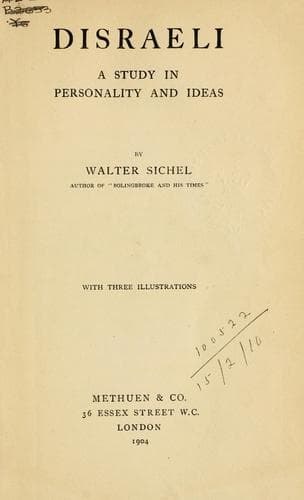
Disraeli: A Study in Personality and IdeasSichel, Walter
History
Disraeli: A Study in Personality and Ideas
Sichel, Walter
Disraeli, Benjamin, 1804-1881
The “real throne,” as against the ornamental, formed a very material
part of it. It chimed with Disraeli’s outlook on English institutions
as “popular, but not democratic.” Since _Sybil_ was written, the
“subject” is no longer “a serf,” but for a long time the “sceptre”
tended to remain “a pageant.” The constitutional possibilities and
opportunities of kingship under our limited monarchy are even now,
perhaps, hardly realised. Before I close this chapter, I intend to say
something of their historical lineage.
There is a satirical passage about George the Fourth among the
brilliant flippancies of _Vivian Grey_, which may amuse us before
coming to close quarters with the serious side of sovereignty: “The
first great duty of a monarch is to know how to bow skilfully. Nothing
is more difficult, ... a royal bow may often quell a rebellion, and
sometimes crush a conspiracy. Our own Sovereign bows to perfection. His
bow is eloquent, and will always render an oration ... unnecessary,
which is a great point, for harangues are not regal. Nothing is
more undignified than to make a speech. It is from the first an
acknowledgment that you are under the necessity of explaining, or
conciliating, or convincing, or confuting; in short, that you are not
omnipotent, but opposed.”
“The Monarchy of the Tories is more democratic than the Republic of
the Whigs!” exclaimed Disraeli, as I have already quoted, in his
early _Spirit of Whiggism_. “I think,” cried Canning in 1812, “that
we have the happiness to live under a limited monarchy, not under a
crowned republic;” while, six years later, Canning again denounced
most forcibly the error of those “who argue as if the constitution of
this country was a broad and level democracy inlaid (for ornament’s
sake) with a peerage and topped (by sufferance) with a crown.” This
belief inspired the same statesman when, towards the agitated close of
his days, he speaks in a letter to Mr. Croker of his reliance on the
“vigour of the Crown” in conjunction with the “body of the people.”
This, too, was the belief that inspired Disraeli. “_The monarch and the
multitude._” Monarchy should be neither a gewgaw nor an abstraction,
but a centre of national enthusiasm. “It is enthusiasm alone that gives
flesh and blood to the skeletons of opinions.” From the beginning of
the first to the close of the fifth decade of last century kingship
had been on its trial in England. “The Tories,” wrote Disraeli in _The
Press_, “already recognised the necessity of employing all the popular
elements of the Constitution in support of its monarchical foundation.”
Public-domain text, read in full here on John Shaqi.
Reviews
Reviews
No reviews yet
Be the first to share your thoughts on this work.
Elsewhere in the archive
Join the Discussion
Join the discussion
Sign in to leave a comment or review.
Sign InorCreate an account