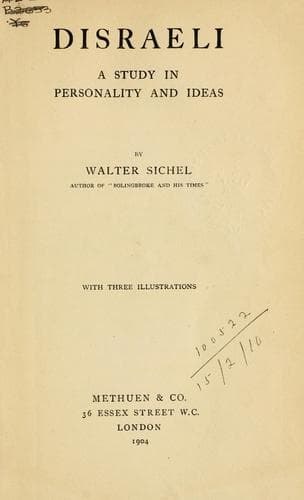
Disraeli: A Study in Personality and IdeasSichel, Walter
History
Disraeli: A Study in Personality and Ideas
Sichel, Walter
Disraeli, Benjamin, 1804-1881
Now, undoubtedly the period to which these words refer was one when
certain Whig leaders contemplated an oligarchical republic, and wished
to compass their aim by an undue exaltation of the Lower House, as,
in 1718, Sunderland had wished to attain the same end by that of the
Upper. No student of the Croker Papers can fail to recognise the
fact, and undoubtedly Disraeli thought--and Sir Robert Peel thought
so too--that the times were ripe for reviving those constitutional
prerogatives, those kingly privileges which form the Crown’s sole
direct representative faculty in the constitution, of which the Crown
had long been robbed, first by its own alternate abuse or incapacity
to use them, afterwards by faction itself often imitating the royal
errors. And so the executive power had passed almost wholly into
ministerial hands. After 1830 the prerogatives which, as I shall show,
Mr. Gladstone champions, seemed falling into entire abeyance. In 1836,
before he had entered Parliament, Disraeli had, in the _Runnymede
Letters_, where he spoke of “the people of England sighing once more
to be a nation,” called on Sir Robert Peel to achieve “a great task
in a great spirit”--“_rescue your Sovereign from an unconstitutional
thraldom_; rescue an august Senate which has already fought the battle
of the people; rescue our National Church which our opponents hate,
our venerable constitution at which they scoff; but, above all, rescue
that mighty body of which all these great classes and institutions are
but one of the constituent and essential parts--rescue the _nation_.”
In 1837, “our young Queen and our old Institutions” were no mere
catchwords. And it seems unquestionable, also, that the subsequent
interferences of Baron Stockmar, the late Queen’s early tutelage to
Lord Melbourne, the circumstances attendant on her happy marriage,
the peculiar treatment of Prince Consort by her first ministers, and
the long retirement due to private grief, contributed in successive
combination towards that invisibility, so to speak, of her royal
office, which prevailed, though it did not, however, eventually
preclude her very real and valuable exercise of it. In England the only
true blemish of our party system, which Disraeli vehemently fought to
uphold, is, as he more than once urged, that it tends to “warp the
intelligence.” To this fault the wisdom of a constitutional and popular
monarch, above and beyond party, offers an antidote.
Sir Robert Peel, in the very year of Queen Victoria’s accession, writes
to Croker as follows:--
Public-domain text, read in full here on John Shaqi.
Reviews
Reviews
No reviews yet
Be the first to share your thoughts on this work.
Elsewhere in the archive
Join the Discussion
Join the discussion
Sign in to leave a comment or review.
Sign InorCreate an account