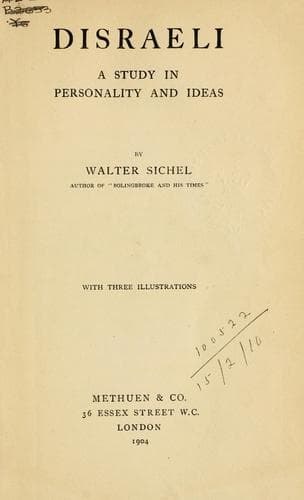
Disraeli: A Study in Personality and IdeasSichel, Walter
History
Disraeli: A Study in Personality and Ideas
Sichel, Walter
Disraeli, Benjamin, 1804-1881
“... The theory of the constitution is that the King has no will except
in the choice of his ministers.... _But this, like a thousand other
theories, is at variance with the fact._ The personal character of
the sovereign ... has an immense practical effect.... There may not
be violent collisions between the King and his Government, but his
influence, though dormant and unseen, may be very powerful. Respect
for personal character will operate in some cases; in others the King
will have all the authority which greater and more widely extended
experience than that of any single minister will naturally give. A
King, after a reign of ten years, ought to know much more of the
working of the machine of government than any other man in the country.
_He is the centre to which all business gravitates._ The knowledge that
the King holds firmly a certain opinion, and will abide by it, prevents
in many cases an opposite opinion being offered to him.... The personal
character of a really constitutional King, of mature age, of experience
in public affairs, and knowledge, manners, and customs, is practically
so much _ballast_, keeping the vessel of the State steady in her
course, countervailing the levity of popular ministers, of orators
forced by oratory into public councils, the blasts of democratic
passions, the groundswell of discontent, and ‘the ignorant impatience
for the relaxation of taxation.’ ... The genius of the Constitution had
contrived this in times gone by.
“‘Speluncis abdidit atris
Hoc metuens, molemque et montes insuper altos
Imposuit, _Regemque_ dedit, qui fœdere certo
Et premere, et laxas sciret dare jussus habenas.’
“If at other times this _paternal authority_[110] were requisite,
the authority to be exercised _fœdere certo_, by the nice tact of an
experienced hand, how much more is it necessary when every institution
is reeling, when
_‘Excutimur cursu, et cœcis erramus in undis’!_”
Sir Robert’s idea, then, of a constitutional sovereign was that of
an unseen driver who holds the reins from within. The sailor-king
of narrow mind but broad sympathies, just departed when Peel wrote,
had not proved a cipher. He insisted on being for a space Lord High
Admiral, despite Croker’s ungenerous retort that James II. had done
the same. In 1828 he had offered wise advice to his ministers as to
the unripeness of the times for a change in the form then proposed,
which touched his heart. On his accession he emphatically expressed his
pleasure in retaining his ministers. And, though he composed a couplet
so bad that it might have been the jingle of Harley--
“_A dissolution
Means revolution_,”
Public-domain text, read in full here on John Shaqi.
Reviews
Reviews
No reviews yet
Be the first to share your thoughts on this work.
Elsewhere in the archive
Join the Discussion
Join the discussion
Sign in to leave a comment or review.
Sign InorCreate an account