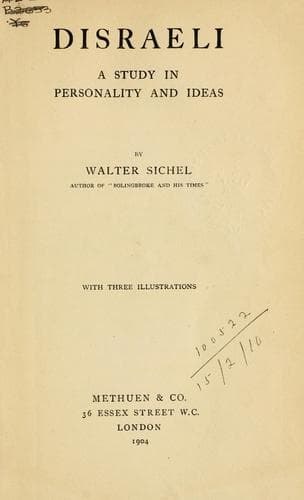
Disraeli: A Study in Personality and IdeasSichel, Walter
History
Disraeli: A Study in Personality and Ideas
Sichel, Walter
Disraeli, Benjamin, 1804-1881
These ideas, in happier times and altered circumstances, passed
to Disraeli. In 1859, repeating in part what he had affirmed of
“Bolingbroke” in the Letter to Lord Lyndhurst, indited nearly
twenty-five years earlier, he said of the Conservative party: “... In
attempting, however humbly, to regulate its fortunes, I have always
striven to distinguish that which was eternal from that which was but
accidental in its opinions. I have always striven to assist in building
it upon a _broad and national_ basis, because I believed it to be a
party peculiarly and essentially _national_--a party which adhered to
the institutions of the country as embodying the national necessities
and forming the best security for the liberty, the power, and the
prosperity of England.”
In his Runnymede Letter to Peel of 1836, he calls on him to head this
“national party.” In his Crystal Palace oration of 1872, he showed that
the ideal of a “Conservative” party seeking to preserve, adapt, and
expand traditional institutions is to be national. In this striking
speech, after deprecating that, in the days of Eldon, “... instead of
the principles professed by Mr. Pitt and Lord Grenville, and which
those great men inherited ‘from predecessors’ not less illustrious,
the Tory system had degenerated into a policy which formed an adequate
basis on the principles of exclusiveness and restriction,” he urged,
as he had always urged: “... The Tory party, unless it is a national
party, is nothing. It is not a confederacy of nobles, it is not a
democratic multitude; it is a party formed from all the numerous
classes in the realm--classes alike and equal before the law, but whose
different conditions and different aims give vigour and variety to our
national life.”
For the essence of these ideas, the forms which have since appeared or
vanished--the development of the ministerial system, the organisation
of public opinion--are immaterial. Of course Bolingbroke could not
foresee the _routine_ of the far future; it was its _spirit_ which
he foresaw, and to which, through Disraeli, he contributed. In his
own language about another, he “... _had the wisdom to discern, not
only the actual alteration which was already made, but the growing
alteration which would every day increase_.” And this, too, may be
affirmed of Disraeli.
I think that, in the denial of Bolingbroke’s real objects, achieved by
Disraeli, some misconception has arisen from the constant use towards
the close of the eighteenth century of “to govern by party connections.”
Public-domain text, read in full here on John Shaqi.
Reviews
Reviews
No reviews yet
Be the first to share your thoughts on this work.
Elsewhere in the archive
Join the Discussion
Join the discussion
Sign in to leave a comment or review.
Sign InorCreate an account