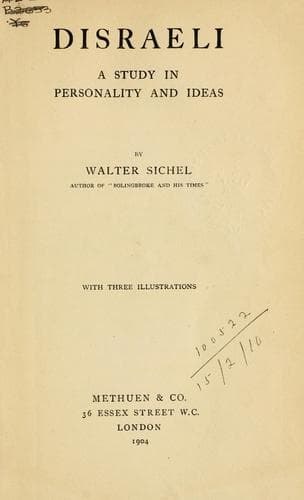
Disraeli: A Study in Personality and IdeasSichel, Walter
History
Disraeli: A Study in Personality and Ideas
Sichel, Walter
Disraeli, Benjamin, 1804-1881
It has been objected that Bolingbroke’s aim was for the King to “defy
Parliament.” Nothing could be further from the truth. Throughout his
writings he champions the rights of Parliament; indeed, Parliament was
his hobby. In his treatise on the “Patriot King,” the word “Parliament”
is not employed--it is his only essay from which it is absent--but the
phrase “the people,” that is, has been expressly defined by him as the
whole nation in its capacities, representative as well as collective.
It therefore includes “Parliament.” In Bolingbroke’s previous “Spirit
of Patriotism,” he had approached the theme of national regeneration
from the standpoint of the ideal citizen; in the “Patriot King,” from
the standpoint of a throne in accord with national concurrence. Its
whole pith is that the ideal King, governing through ministers and
through party, should rise above and beyond them. He must be neither
a partisan (as all the Georges proved), nor a puppet, nor (as Canning
long afterwards repeated) “the tool of a confederacy,” but in alliance
with and reliance on the whole body of his subjects. The “Patriot King”
is expressly urged “to confine instead of labouring to extend his
prerogative;” and Bolingbroke adds that such an ideal would be derided
by his own generation.
Of Elizabeth herself, whose great example is his perpetual praise, he
has observed elsewhere that, “instead of struggling through trouble and
danger to bend the constitution to any particular views of her own, she
accommodated her notions, her views, and her whole character to it;”
and he proceeds to say, “a free people expects this of their prince. He
is made for their sakes, not they for his;” and again, “the merit of
a wise governor is wisely to superintend the whole.” He expresses his
ideal of an impartial and democratic King in his “Spirit of Patriotism”
as of one who should “_govern all by all_.” He further, in many direct
passages, distinctly looks forward to a transference of power from
caballing cliques led by selfish ambition, to the nation at large, and
he calls on the King to be a truly national ruler. He desires, under
changes, descried in the dim distance, that the “_sense of the Court,
the sense of the Parliament, and the sense of the People should be the
same_;” that the King, as he expresses it, should prove the “centre of
the nation,” and, as Disraeli has expressed it, should be above “class
interests;” should, in a country of classes, respond to every class,
and favouritise none. To this end he harped, as did Disraeli from
first to last, on what he admits to be a seeming solecism--a “National
Party;” and by this he means--as I could prove by countless passages--a
party whose main object is _national and imperial unity_; one that is,
moreover, comprehensive instead of being exclusive.
Public-domain text, read in full here on John Shaqi.
Reviews
Reviews
No reviews yet
Be the first to share your thoughts on this work.
Elsewhere in the archive
Join the Discussion
Join the discussion
Sign in to leave a comment or review.
Sign InorCreate an account