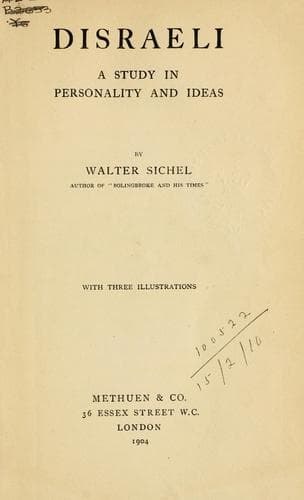
Disraeli: A Study in Personality and IdeasSichel, Walter
History
Disraeli: A Study in Personality and Ideas
Sichel, Walter
Disraeli, Benjamin, 1804-1881
“... There is a great difference between ancient and modern colonies.
A modern colony is a commercial enterprise, an ancient colony was a
political sentiment. In the emigration of our citizens, hitherto, _we
have merely sought the means of acquiring wealth_; the ancients, when
their brethren quitted their native shores, wept and sacrificed, and
were reconciled to the loss of their fellow-citizens solely by the
constraint of stern necessity, and the hope that they were about to
find easier subsistence, and to lead a more cheerful and commodious
life. _I believe that a great revolution is at hand in our system of
colonisation, and that Europe will soon recur to the principles of the
ancient polity._” In 1836 he thus satirises the impending King’s speech
in his Runnymede Letter to Lord Melbourne--
“... It will announce to us that in our colonial empire the most
important results may speedily be anticipated from the discreet
selection of Lord Auckland as a successor to our Clives and our
Hastings; that the progressive improvement of the French in the
manufacture of beetroot may compensate for the approaching destruction
of our West Indian plantations;[113] and that, although Canada is not
yet independent, the final triumph of liberal principles, under the
immediate patronage of the Government, may eventually console us for
the loss of the glory of Chatham and the conquests of Wolfe.”
Once in the House of Commons, he never ceased to urge the claims of
sentiment and the bonds of interest, while he enforced the necessity
for cementing them by federation and by tariffs. In 1848, when Lord
Palmerston, with his “perfumed cane,” was dictating a constitution
to Narvaez, Disraeli, who on principle deprecated interference with
foreign powers unless British interests were endangered, here supported
him, just because he considered it a case with contingencies affecting
our colonial welfare and our own prestige. It was in 1848, too, that,
descanting on the narrowing aspects of the Manchester School, and their
“unblushing” advocacy of the “interests of capital,” he indicted their
“colonial reform with ruining the colonies.” It was in the same year
that he taxed the self-righteous Peelites with “turning up their noses
at East India cotton as at everything else Colonial and Imperial.”[114]
Public-domain text, read in full here on John Shaqi.
Reviews
Reviews
No reviews yet
Be the first to share your thoughts on this work.
Elsewhere in the archive
Join the Discussion
Join the discussion
Sign in to leave a comment or review.
Sign InorCreate an account