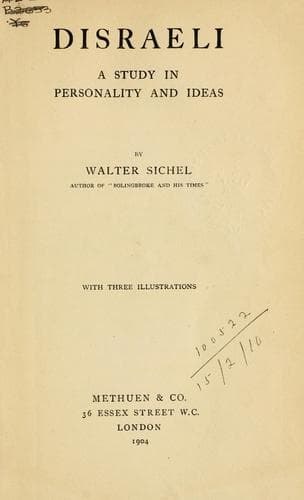
Disraeli: A Study in Personality and IdeasSichel, Walter
History
Disraeli: A Study in Personality and Ideas
Sichel, Walter
Disraeli, Benjamin, 1804-1881
Under Governments, of which Disraeli was the leading spirit, a
constitution was framed for New Zealand in 1852, and in the summer
of 1858 the colony of British Columbia was established. It was not
more than a few months afterwards that disturbances arose; and the
_Times_, in its review of the year 1859, found in these elements only
the “incubus” of ubiquitous colonies and commerce. To this standing
snarl about “the millstone of the colonies and India” Disraeli adverted
thirteen years afterwards, when he said: “... It has been shown with
precise, with mathematical demonstration, that there never was a jewel
in the Crown of England that was so truly costly.... How often has it
been suggested that we should emancipate ourselves from this incubus!”
It was Disraeli’s Government that in the ’sixties was to confederate
Canada, and in the ’seventies to devise a scheme for confederating
South Africa. In his earliest pamphlets Disraeli had announced that
the genius of the age was one of a transition from the “feodal” to the
“federal.” In his whole outlook throughout he sought to reconcile the
higher spirit of the one with the material interests of the other.
And yet, astounding to relate, it was stated in a speech some seven
years or so ago, that Disraeli himself had endorsed such melancholy
and shortsighted pettiness. The sole foundation that I have been able
to find is a stray sentence in a light letter to Lord Malmesbury; just
as in 1863 he made merry in Parliament over those who regarded the
“colonial empire” as an “annual burden.”
Public-domain text, read in full here on John Shaqi.
Reviews
Reviews
No reviews yet
Be the first to share your thoughts on this work.
Elsewhere in the archive
Join the Discussion
Join the discussion
Sign in to leave a comment or review.
Sign InorCreate an account